
The Complete Guide to Water Sort Puzzles
Pour with purpose: workspace discipline, two-move planning, and smart undo habits that sort every bottle cleanly.
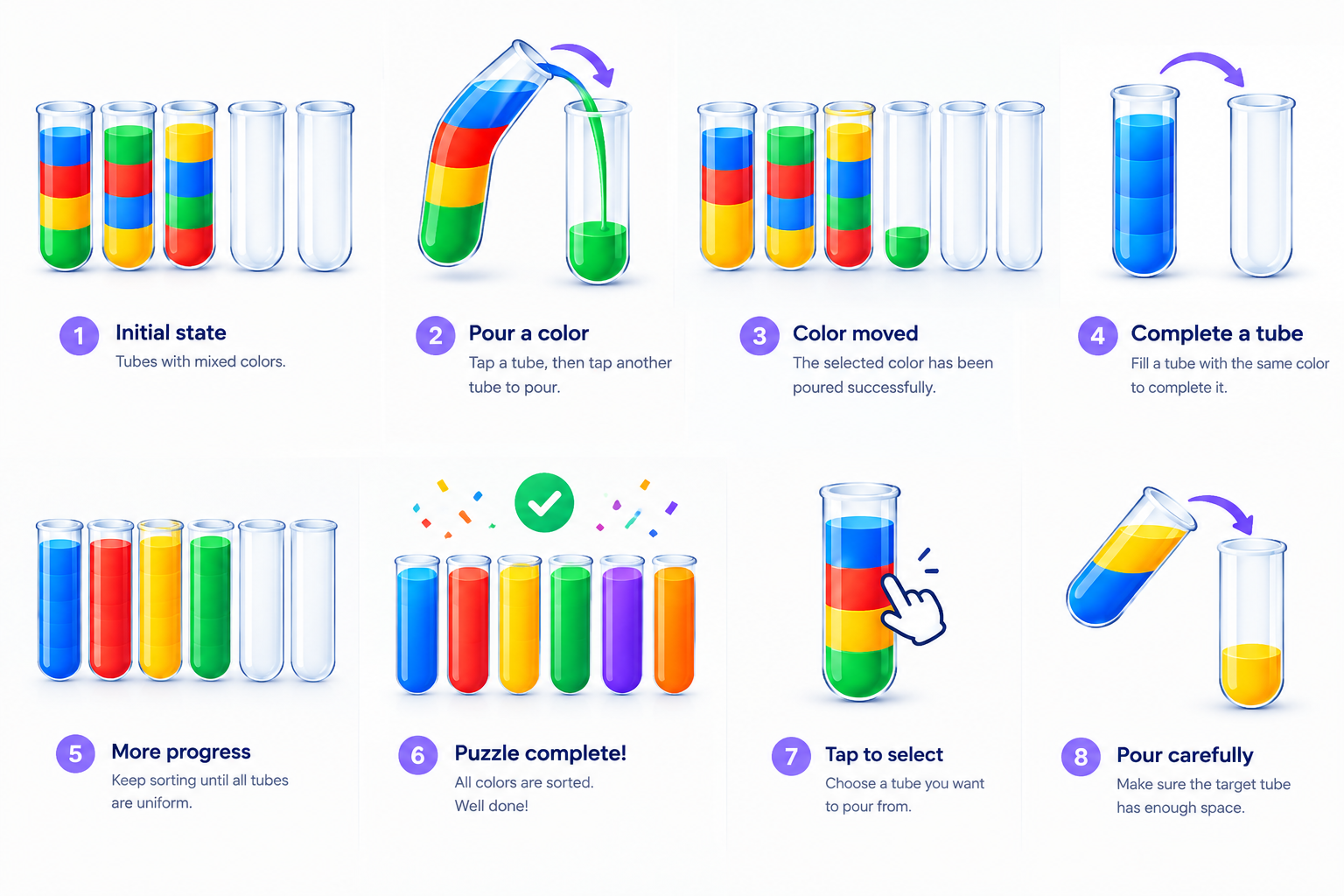
How Sorting Works
Every bottle holds up to 4 units of colored water. Tap a bottle to select it, then tap a target to pour one unit of the top color across. A pour is legal in only two cases: the target’s top color matches, or the target is empty. You can never pour one color on top of another.
You win by sorting: every bottle ends holding 4 units of a single color — or empty. Two things to know:
- 3,000 levels, one continuous ramp: there are no Easy/Medium/Hard tiers to pick — difficulty climbs steadily across the 3,000-level journey, from 4 colours at the start up to 11 later on.
- Every level is solvable: the site verifies solvability before offering a level, so a clean solution always exists. A stuck position means a wrong turn, never a dead end.
The Empty Bottle Is Your Workspace
Empty space is the real resource in Water Sort. Colors are easy to move but hard to shuffle, and the empty bottle is the only place shuffling can happen.
- Guard your empties: keep at least one bottle empty as long as you can, and do not top it up early just because a legal move sits there.
- Use it to unbury colors: pour the blockers sitting above a buried color into the empty bottle, free the color underneath, then consolidate it where it belongs.
- Two empties enable chains: with two empty bottles you can run long shuffling sequences — but always keep one exit open so a chain cannot trap you.
- Fill it last: the workspace bottle usually becomes the home of whichever color you sort last.
Plan Two Moves Ahead
The difference between a clean solve and a tangled board is one question asked before each pour: what happens after this?
- Check the next layer: before pouring from a bottle, look at what color will be exposed once the top unit leaves — and where that color will go next.
- Look underneath before consolidating: pouring more of a color into a bottle that hides a different color at the bottom can bury it under a full stack. Consolidating too eagerly is the most common self-inflicted trap.
- Follow the chain: most pours unlock the next pour. Trace the sequence two or three moves deep before committing, and only start chains you can see the end of.
- Prefer progress moves: favor pours that empty a bottle or extend a finished color, and skip busywork that just shifts water sideways.
When to Undo (and When to Restart)
Undo and restart carry no penalty — use them without guilt. Knowing when is what separates fast solves from slow ones.
- Undo the moment a pour blocks your plan: step back instead of forcing a worse follow-up on top of a mistake.
- Undo in chunks: if a chain of moves went wrong, unwind several steps until you reach the position you actually wanted.
- Restart early when the opening goes bad: a fresh board often sorts faster than patching a tangled one. If you are five moves in and the board already feels wrong, restart.
- Experiment freely: try the risky pour, watch what it unlocks, and undo if it fails. With free undo, exploration is cheaper than guesswork.
How Races Work
Race mode moves the puzzle online and turns it into a head-to-head contest:
- Same seed, same board: both players receive the identical layout generated from the same seed, so the race is pure skill and speed — no luck in who gets the easier puzzle.
- First finisher wins: speed comes from fewer wasted pours, not frantic tapping.
- Practice patterns offline: solving solo levels in single-player teaches you to recognize layouts on sight — where races are won.
Conclusion: Sort Smart, Not Fast
Water Sort is a planning game dressed up as a tapping game. Treat empty bottles as workspace, ask what happens two moves ahead before every pour, and let undo fix the wrong turns instead of stacking mistakes. Every level is solvable — the only question is whether you find the clean route or the scenic one.