The Complete Guide to Playing and Mastering 2048
Learn the rules behind the sliding-number puzzle, the strategy that consistently produces high tiles, and how to use the undo button to recover from mis-swipes.
1. How 2048 Actually Works
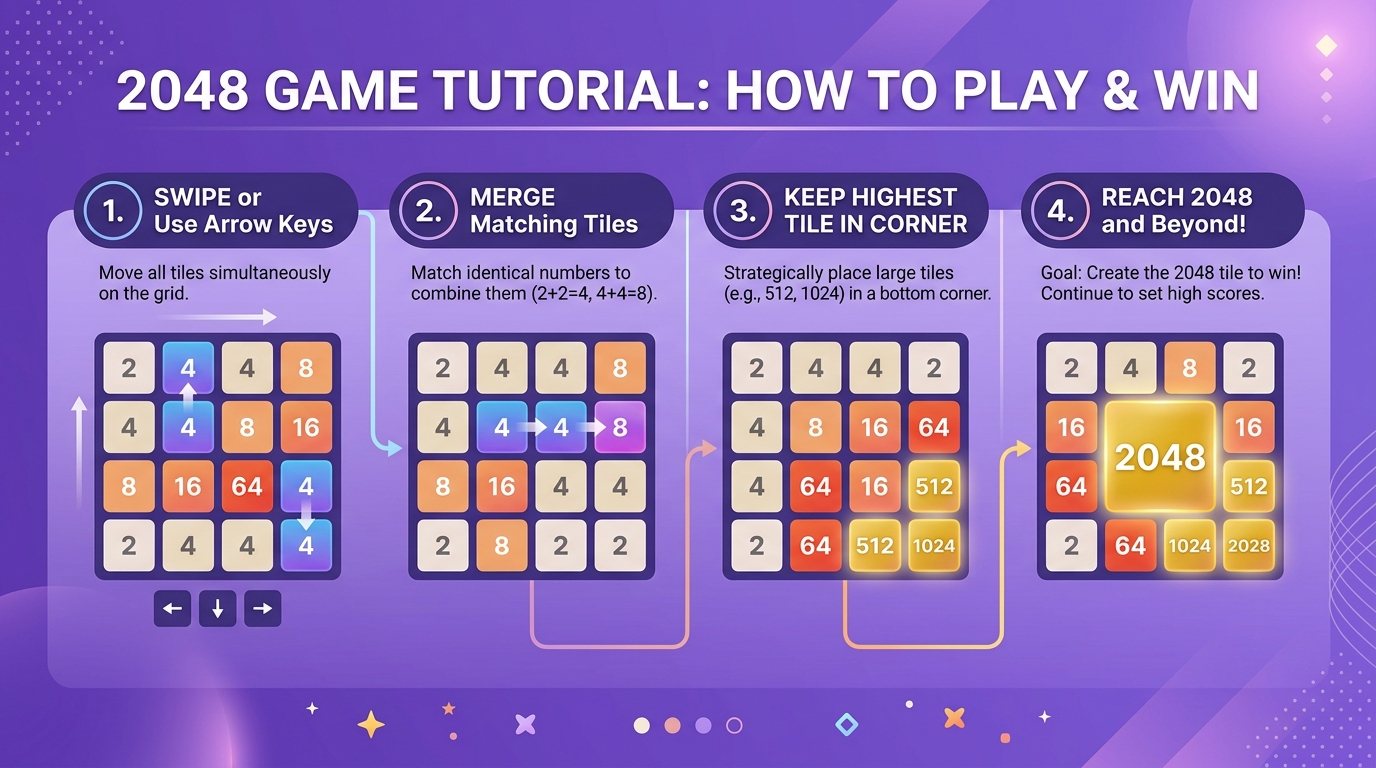
A 2048 board starts with two tiles already placed, always a pair of 2s or 4s in random empty cells. Every time you press an arrow key (or swipe on a touchscreen), the entire grid slides as far as it can in that direction. Whenever two tiles carrying the same number collide during a slide, they fuse into a single tile worth their combined value, and your score grows by that value. After every successful move, a new 2 or 4 (90 percent chance of 2, 10 percent chance of 4) appears in a random empty cell.
The game ends when no empty cell remains and no neighboring tiles share a value, meaning no further merges are possible. Reaching the 2048 tile triggers the win banner, but the board keeps going. A tile worth 2048 is only the official finish line; you can keep pushing to 4096, 8192, and beyond if the grid has room.
2. The Corner Strategy That Almost Always Wins
Skilled players do not swipe randomly. The most reliable approach is the corner strategy: choose a corner (most players pick the bottom-left) and keep your highest-value tile pinned there for the entire game. You accomplish this by only ever pressing two directions, for the bottom-left corner that means only down and left. The third and fourth directions are reserved for emergencies.
Because every slide pushes your big tile back into the corner, it never drifts away from where you anchored it. Smaller tiles stack up next to it in descending order, so when the chain of merges finally propagates inward toward the corner, all those small tiles fold into the big one in a single satisfying cascade.
3. Choosing a Grid Size That Suits You
The classic 2048 puzzle uses a 4x4 grid, which sits right at the edge of difficulty: tight enough that you must plan, large enough that a thoughtful player can reach 2048 most sessions. A 5x5 grid makes the game noticeably more forgiving. The extra row and column give you breathing room and let you stage more merges before the board fills up. A 6x6 grid is for high-score chasers who want to chase 4096 or 8192 without choking.
If you find yourself stuck on 4x4 before reaching the goal tile, drop down to 5x5 for a few rounds to internalize the corner strategy. Then come back. The smaller grid forces sharper play, and your scores will jump.
4. Using the Undo Button Wisely
Our 2048 gives you 5 free undos per run. Need more? Buy extra from the in-game store with coins. Undo is not a crutch, it is a planning tool. When you accidentally swipe in the wrong direction and your anchor tile slides out of the corner, undo instead of scrambling to recover. When a single merge forces a chain reaction that strands your biggest tile in the middle of the board, undo and try a different order.
Be aware that undo restores both the prior grid and the score you had at that point. So you cannot use it to walk back a wrong move and still keep the points gained there. Treat each undo as a fresh start from the chosen position.
Two Directions Are All You Need
2048 is one of those rare puzzle games where a small strategic insight, keeping your biggest tile in a corner and swiping using only two directions, turns a frustrating board into a satisfying cascade. ToolWise Free Online 2048 gives you the classic grid, fast keyboard and swipe controls, an undo buffer to recover from mistakes, and a persistent best score stored in your browser. Pick a grid size, swipe, and start climbing.