
The Complete Guide to Block Puzzle
Learn how the 8×8 grid, the combo scoring, the abilities spin and race modes work — plus the placement principles that keep your board alive for high scores.
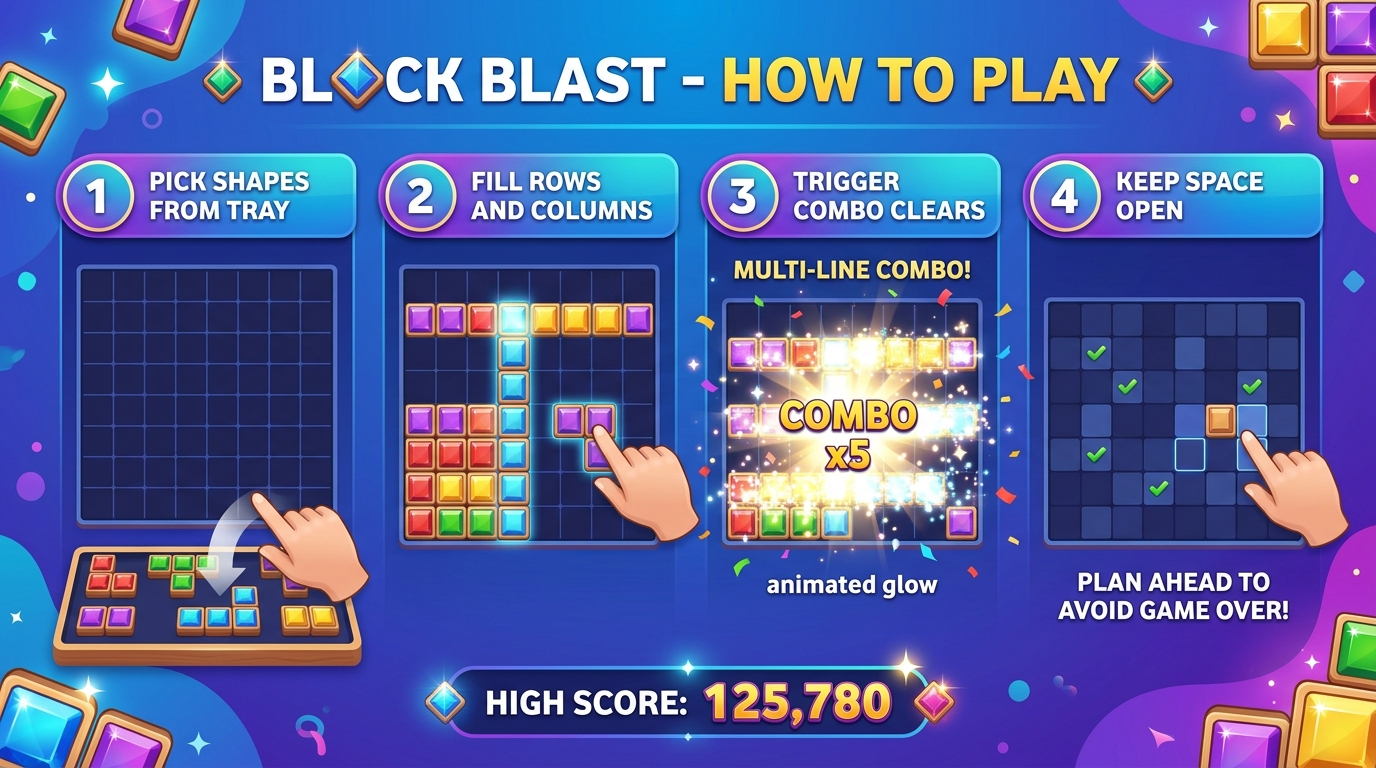
How the Game Works
Block Puzzle is a game of placement and clearing on an 8×8 grid — no gravity, no falling pieces and no timer in solo play. You drag each shape from the tray beside the board to any spot on the grid.
- 8×8 grid, three shapes at a time: each turn deals three shapes into the tray — place them anywhere, and a new trio appears when the tray empties.
- Clear full rows and columns: complete an entire row or column and it clears from the board, freeing space.
- Scoring: 10 points per tile placed, plus 50 for the first line cleared in a move, plus 90 for each additional line cleared in that same move — all scaled by your combo multiplier.
- The end condition: the game ends when none of the three tray shapes fits anywhere. There is no clock; you lose the moment the tray is unplayable.
- Abilities: Fresh Pieces re-deals the tray, Undo takes back the last placement, Hammer destroys one block and Bomb clears a 3×3 area — earned from the daily reward or bought in the store.
Work through the 3,000-level journey — each level asks you to clear a target number of lines from a fixed piece sequence the generator has already solved — play Endless for a pure score attack, or race up to 8 players online on an identical piece queue.
Keep the Board Flat
The defining principle of Block Puzzle: a flat board is a survivable board. Runs end not for lack of points, but because a hole or spike left nowhere for the next shape.
- Fill holes immediately: an empty cell surrounded by placed tiles is nearly unusable — almost nothing fits a one-cell gap. Patch it the moment it appears.
- Avoid spikes: tall single columns create pockets beside them — build evenly across rows instead of upward.
- Hug the edges and corners: anchoring shapes along the border keeps the middle flexible — and the middle is where big shapes need room.
- Think one tray ahead: before placing, glance at the other two tray shapes and make sure each has a home after this move.
Save the Big Shapes for Clears
Long straight shapes and large L-shapes are the hardest pieces to place — and the most powerful. Treat them as line-clearing tools, not clutter.
- Use long shapes to clear lines: a five-tile straight shape is the best line finisher — slide it into a row or column three or four tiles from complete.
- Do not waste big shapes on awkward gaps: forcing a large piece into an odd corner often creates worse problems than it solves.
- Carve space early: when a big shape appears, flatten space for it now rather than being forced into a bad spot later.
- Small shapes are for patching: use one-cell pieces to fill holes and level the board; save big pieces for the payoff.
The Combo Multiplier
The scoring math makes multi-line clears enormously valuable: the first cleared line is worth 50 points, each additional line in the same move 90. A double clear pays 140, a triple 230 — the same lines cleared separately would earn just 50 each.
On top of that, clearing on consecutive placements builds a combo chain. The line bonus is multiplied by the length of the chain — ×2 on the second consecutive clearing placement, ×3 on the third, up to ×5 — and a placement that clears nothing resets the chain to zero. The placement points (10 per tile) are never multiplied, only the line bonus, so a deliberate setup move that clears nothing is cheap insurance for the next big clear.
- Set up intersections: a shape placed where a nearly-complete row and column cross can clear both at once — when two lines are each one shape away, finish both together.
- Chain your clears: keep a spare line ready so the placement after a clear also clears something; the multiplier is worth far more than the tiles you spend on it.
- Do not force it: if a combo requires wrecking your flatness, the lost space can cost more than the bonus earns.
Abilities and Second Chances
Four board tools are available, each with a count shown on its round button in the tray beside the board:
- Fresh Pieces: re-deals the tray with three new shapes when the current trio has nowhere good to go.
- Undo: takes back the last placement, restoring the board, score and tray exactly as they were — and it still works after the run ends, so a misplacement that fills the board can be rewound.
- Hammer: destroys any single block. Tap the hammer, then tap the block you want gone; use it to open a pocket for an awkward piece.
- Bomb: clears the 3×3 area around the cell you tap — the strongest tool, and the one that can rescue a run that has no legal placement left.
When no tray shape fits anywhere the run-over dialog appears. If you still hold a Bomb (or an Undo), it offers that second chance directly: use it, and if the cleared space gives a shape a home, the run continues with your score intact. Otherwise press Play again for a fresh board. Tools come from the daily reward calendar and the store.
How Races Work
An online race is a fair fight: every player gets their own empty board, but the host broadcasts a single piece-queue seed, so all racers receive the exact same shapes in the exact same order. Every point gap comes from skill, not luck. The host also sets the rules before starting:
- Score: play until nothing fits — the highest final score wins.
- Timed: the host picks 2, 3 or 5 minutes; when the shared clock hits zero the score is final.
- Lines: first to 10, 20 or 30 cleared lines triggers the finish — the field is then ranked by score.
- Ability allowances: the host grants each player 0–3 Undos, Hammers and Bombs for the race. Race tools come from that allowance, never from your own store credits, and Fresh Pieces is switched off so the shared queue stays fair.
Highest final score takes the race, and the ranked table shows everyone’s lines cleared underneath their score. Online races never touch journey progress or the global leaderboard. Play for survival first: since the game only ends when nothing fits, the flattest board gets the most turns — and the most chances to score.
The Scoring Math Behind Clear Lines
Block Puzzle is easy to pick up — drag three shapes, clear some lines — but its depth hides in the scoring math. Keep the board flat so every tray has somewhere to go, save big shapes for finishing lines, and chain consecutive clears to push the combo multiplier toward ×5. When the board finally locks up, a Bomb or an Undo buys the run back. In a race the seed makes the shapes identical, so only your board management separates you. Play patiently, protect your space, and the points will follow.