The Complete Guide to Flow Free
Learn how path drawing, the fill-the-board rule, the board clock, and online races work — plus the solving habits that make you fast on every grid size.
How the Game Works
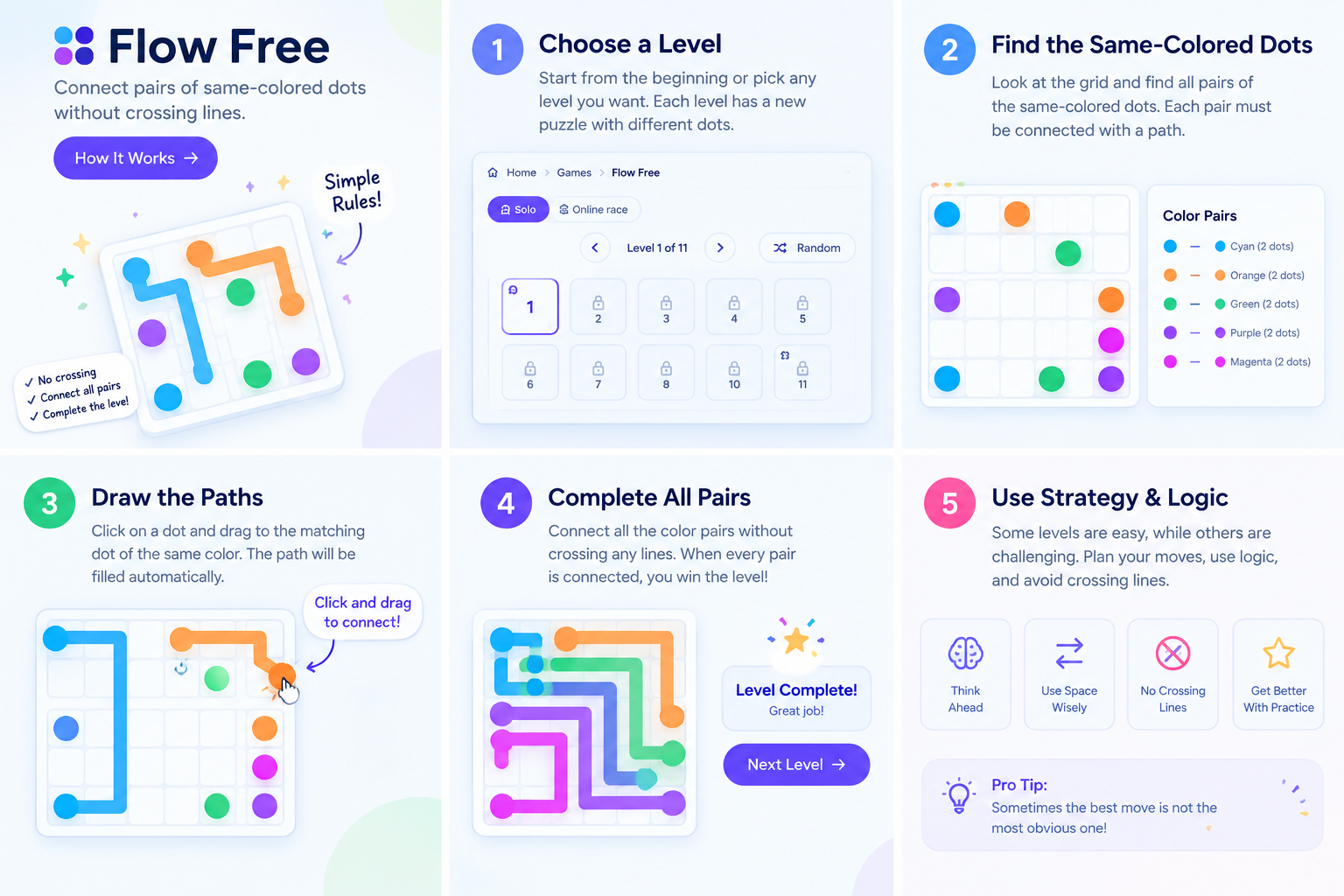
Flow Free is a path-drawing puzzle: a grid scattered with pairs of colored dots, and your job is to connect every matching pair with a continuous line.
- Drag from a dot to extend the line: press on a colored dot and drag through the grid — the line stretches cell by cell until it reaches the matching dot.
- Paths cannot cross or overlap: every cell can belong to at most one path, and lines cannot intersect each other or themselves.
- Fill the whole board to win: connecting the dots is not enough — every cell must be covered by a path.
- Beat the board clock: solo boards run a generous time trial — 45 seconds plus 20 seconds per color pair, up to five minutes. The Time left chip counts it down, and running out opens a retry dialog rather than a dead end. Want untimed solitaire? Switch Timer off in Settings.
- Count your moves: every committed path that links a color pair is one move. Clear the board with one stroke per color and you have a perfect solve — the fewest moves a board can take.
- 3,000 generated levels: one generator builds every puzzle, scaling from 5×5 up to 9×9, and each board is verified solvable before it ships.
Play through the 3,000-level journey at your own pace — timed or untimed — or race friends online, each of you solving the same levels on your own board.
Start from the Corners
The most reliable habit is to start with the most constrained dots. A corner dot has only two exits, so its path is the most forced on the board.
- Connect corner pairs first: their route is nearly decided for you — solve it first and the rest falls into place.
- Handle edge dots next: edge dots have three exits, the next most constrained — their routes carve up the perimeter.
- Leave flexible centers for last: center dots have four exits and adapt to almost anything — save them until the constrained paths have shaped the board.
- Work from the outside in: solve the perimeter first, then let interior paths fill around what is committed.
The "Fill the Board" Constraint Changes Everything
In most path puzzles the shortest route between two dots is best. In Flow Free it is usually wrong, because the win condition demands every cell be covered. Instead of efficient connections, you weave long, winding snakes through empty space.
- Think coverage, not distance: ask which path can afford to detour through an empty region, not what the fastest connection is.
- Let long paths absorb slack: pairs that sit far apart cover more cells; near pairs leave gaps for other paths to snake into.
- Watch for isolated pockets: if a small region gets walled off by paths with no dot inside, some path must be routed through it — plan that early.
- Empty space is a resource: distribute leftover cells among the paths with the most room to stretch.
Handling Crossings
Because paths cannot cross, every puzzle becomes a routing negotiation: when two natural routes intersect, one has to go around. Deciding which one bends is where solutions are won or lost.
- Treat near-crossings as forks: when two routes want the same cell, one must detour — reroute the one with more room around the other.
- Use crossing pressure as a deduction: if a pair sits on both sides of another pair's obvious route, that route may have to bend — trace both versions to see which keeps the board fillable.
- Solve in the right order: paths drawn first claim territory — draw constrained corner and edge paths before later routes box them in.
- Rework freely: nothing is locked in until the board is full — redraw dead ends and let neighboring paths adjust.
How Online Races Work
Press “Play with a friend online” to race: create a room for 2–8 players (or join one with a code or link) and every player solves their OWN copy of the same level sequence, starting at Level 1.
- The host sets the race: a timer (Off, 1, 2, 3 or 5 minutes), how many levels the race runs to (5, 10 or a custom count) and how many Route Reveals each player may use — or none. A live race locks the settings until it ends.
- Your board is yours alone: everyone races the identical levels on their own grid — no waiting for turns, and nobody can touch your paths.
- Live standings: every solved level counts one point on the standings shown under the room card on all screens, updating as each player clears their board.
- How it ends: reach the level target and your run closes (first finisher ranks highest); with a timer, the clock closes every run at once; with no timer and no target, the host ends the race whenever it is time. Then the ranked final table appears on every screen.
- Race scores stay in the room: solving levels in a race never changes your journey map, your coins or the global leaderboard — it is one friendly contest at a time.
Route for Coverage, Not Speed
Flow Free looks like a simple connect-the-dots game, but the fill-the-board rule turns it into a puzzle about routing and coverage. Start from the corners, treat crossings as forks one path must bend around, and remember the shortest route is rarely the winning one — the paths that snake through empty space are what let the board fill completely. In a race those habits are what push your level count up before the clock or the target ends your run.