Understanding Compound Interest: Complete Calculator Guide
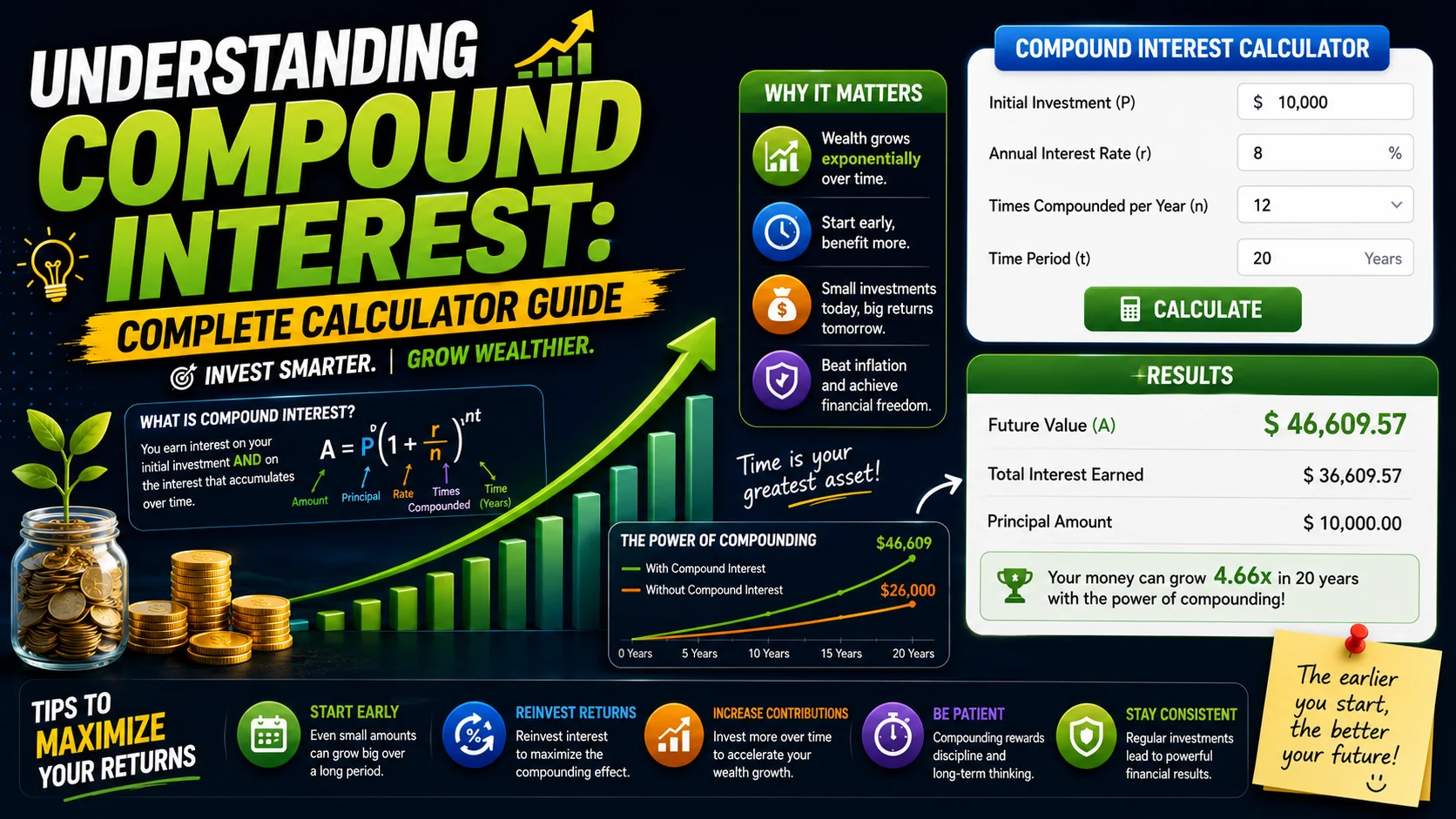
Compound interest is the quiet engine behind almost every long-term fortune. Albert Einstein is often quoted as calling it the “eighth wonder of the world” — and whether or not he really said that, the underlying idea is sound: when your interest starts earning its own interest, money grows in a way that simple arithmetic can barely describe.
What Is Compound Interest?
Compound interest is the process of earning interest not only on your original principal but also on the interest that has already accumulated in previous periods. In other words, your money earns money, and then that new money starts earning money too. Each compounding cycle layers on top of the last, producing growth that accelerates over time rather than moving in a straight line.
To see how powerful this is, imagine you deposit $10,000 into an account that pays 8% interest per year. After the first year you have $10,800 — a tidy $800 gain. But in the second year the same 8% applies to the full $10,800, not just the original $10,000. You earn $864, ending year two with $11,664. By year three your interest is over $933, and the curve keeps steepening. After thirty years of this, with no further deposits, that initial $10,000 has grown to more than $100,000 — none of it from new contributions, all of it from compounding.
This is the fundamental reason financial advisors urge people to start investing early. The earlier your money begins compounding, the more cycles it has to work through, and the more dramatic the final curve becomes. Time, far more than the interest rate, is the dominant variable in long-term wealth building.
The Compound Interest Formula
The standard formula for compound interest, assuming a single lump sum and one compounding period per year, is beautifully compact:
When interest compounds more than once a year, the formula extends to account for the number of compounding periods:
When you also make regular contributions, the full calculation combines the lump-sum growth of the principal with the future-value-of-an-annuity formula applied to each contribution. This is exactly what the ToolWise Compound Interest Calculator handles for you, including taxes, fees, and inflation adjustments that would be tedious to compute by hand.
Simple vs Compound Interest
The clearest way to understand compound interest is to contrast it with simple interest. Simple interest calculates earnings only on the original principal every period, forever — the prior interest sits there inert and never joins the working capital. The difference seems small in year one but turns enormous over decades.
| Years | Simple Interest (8%) | Compound Interest (8%) | Difference |
|---|---|---|---|
| 1 | $10,800 | $10,800 | $0 |
| 5 | $14,000 | $14,693 | $693 |
| 10 | $18,000 | $21,589 | $3,589 |
| 20 | $26,000 | $46,610 | $20,610 |
| 30 | $34,000 | $100,627 | $66,627 |
Notice that in year one the two are identical, and after five years the gap is barely noticeable. But by year thirty the compounding investment is worth roughly three timesthe simple-interest version. This is why the framing of compound interest as “interest on interest” is not a marketing slogan — it is a mathematical fact that becomes more important the longer your time horizon.
How Compounding Frequency Changes Results
The number of times interest is calculated and added back to the principal within a year is called the compounding frequency. More frequent compounding produces a slightly higher future value because each new portion of interest gets to start earning sooner. The effect is real but, for ordinary rates and timeframes, smaller than many people expect.
| Compounding | Periods / Year | Future Value ($10k @ 8% / 30 yr) |
|---|---|---|
| Annually | 1 | $100,627 |
| Semi-annually | 2 | $105,440 |
| Quarterly | 4 | $108,038 |
| Monthly | 12 | $110,203 |
| Daily | 365 | $110,995 |
Going from annual to monthly compounding adds about $9,500 over thirty years on a $10,000 deposit — worthwhile, but nowhere near as impactful as starting ten years earlier or contributing a little every month. In practical terms, compounding frequency matters most for short-term products like savings accounts and certificates of deposit, where it is often the main differentiator between offers.
The Rule of 72: A Mental Shortcut
The Rule of 72 is a back-of-the-napkin method for estimating how long it takes an investment to double at a given annual interest rate. You simply divide 72 by the interest rate (as a whole number), and the result is approximately the number of years to double.
The rule is surprisingly accurate across the range of interest rates most savers and investors encounter. It also works in reverse: divide 72 by the years you have until a goal, and you get the rate you would need in order to double your money in that time. This makes it handy for quickly comparing two investments, or for sanity-checking a projection a salesperson is showing you.
The same logic explains why high-interest debt is so destructive. A credit card charging 24% APR roughly doubles the unpaid balance every three years (72 ÷ 24 = 3). Anyone carrying a balance is experiencing the same compounding force that builds fortunes — only acting in the opposite direction, against them.
Inflation: The Silent Eroder
A future balance of $100,000 sounds impressive, but what matters in practice is what that money can actually buy. Inflation continuously eats away at purchasing power, so a nominal return of 8% in a year with 3% inflation is really only worth about 4.9% in terms of what your money can buy. The formula for real return is:
When you plan for a long-term goal like retirement, it is almost always better to think and project in real terms. The ToolWise Compound Interest Calculator lets you enter an expected inflation rate so the future value it shows is already adjusted — meaning a target of $1 million in today’s dollars will still buy roughly what $1 million buys today, no matter how many years it takes to get there.
How to Use the Compound Interest Calculator
The Compound Interest Calculator removes the manual arithmetic and lets you model realistic scenarios in seconds. Here is a sensible workflow for getting useful numbers out of it:
- Enter your starting amount. This is the principal, or the lump sum you already have. It could be a current savings balance, an inheritance, or simply an initial deposit you intend to make.
- Add your regular contribution. If you plan to keep adding money, enter the monthly amount. Even small recurring deposits have an outsized impact over long horizons because each contribution itself starts compounding.
- Choose a realistic interest rate.For a diversified stock portfolio a long-term average around 7% after inflation is a common assumption; for bonds or high-yield savings use something lower. Resist the temptation to use a hopeful “best year” figure — plan around the average.
- Set the time horizon. This is the single biggest lever. Try running the same numbers at 20 years and 30 years to see how dramatically the later years change the result.
- Account for inflation.Enter an inflation assumption (3% is a reasonable long-term estimate in many economies) so the result is shown in today’s purchasing power.
- Adjust the compounding frequency to match the real product you are considering — monthly for savings, annually for many investment illustrations.
Common Mistakes to Avoid
- Using a too-optimistic rate. Markets have good decades and bad ones. Projecting 12% annual returns because a recent fund did that well will leave you with an unworkable plan. Use a conservative long-term average.
- Ignoring inflation. A million-dollar balance in thirty years will not buy what a million dollars buys today. Always check whether a projection is nominal or real, and prefer real for planning.
- Forgetting fees and taxes. Mutual fund expense ratios, adviser fees, and income or capital-gains taxes all reduce the effective return. Even a 1% annual fee compounds into a large drag over decades.
- Starting late. A saver who starts at 25 and invests $300 a month until 65 will typically end up with more than someone who starts at 35 and invests $600 a month — because the earlier saver gets ten more compounding cycles. Time trumps contributions.
- Underestimating recurring contributions. People focus on the lump sum, but steady monthly deposits are what most households actually rely on. Model them honestly — they matter more than you think.
Frequently Asked Questions
What is the difference between simple and compound interest?
How often is interest typically compounded?
Does the Rule of 72 actually work?
What interest rate should I use in the calculator?
Should I include regular contributions in the calculator?
How does inflation affect compound interest?
Ready to see your money grow?
Use our free Compound Interest Calculator. Plug in your starting amount, monthly contributions, and time horizon to instantly project your future balance — adjusted for inflation and compounding frequency.
Open the Calculator →