
The Complete Guide to Minesweeper and Reading the Numbers
Learn the rules behind the classic minesweeper puzzle, how each numbered cell encodes its neighbors, and why every ToolWise board clears without guessing.
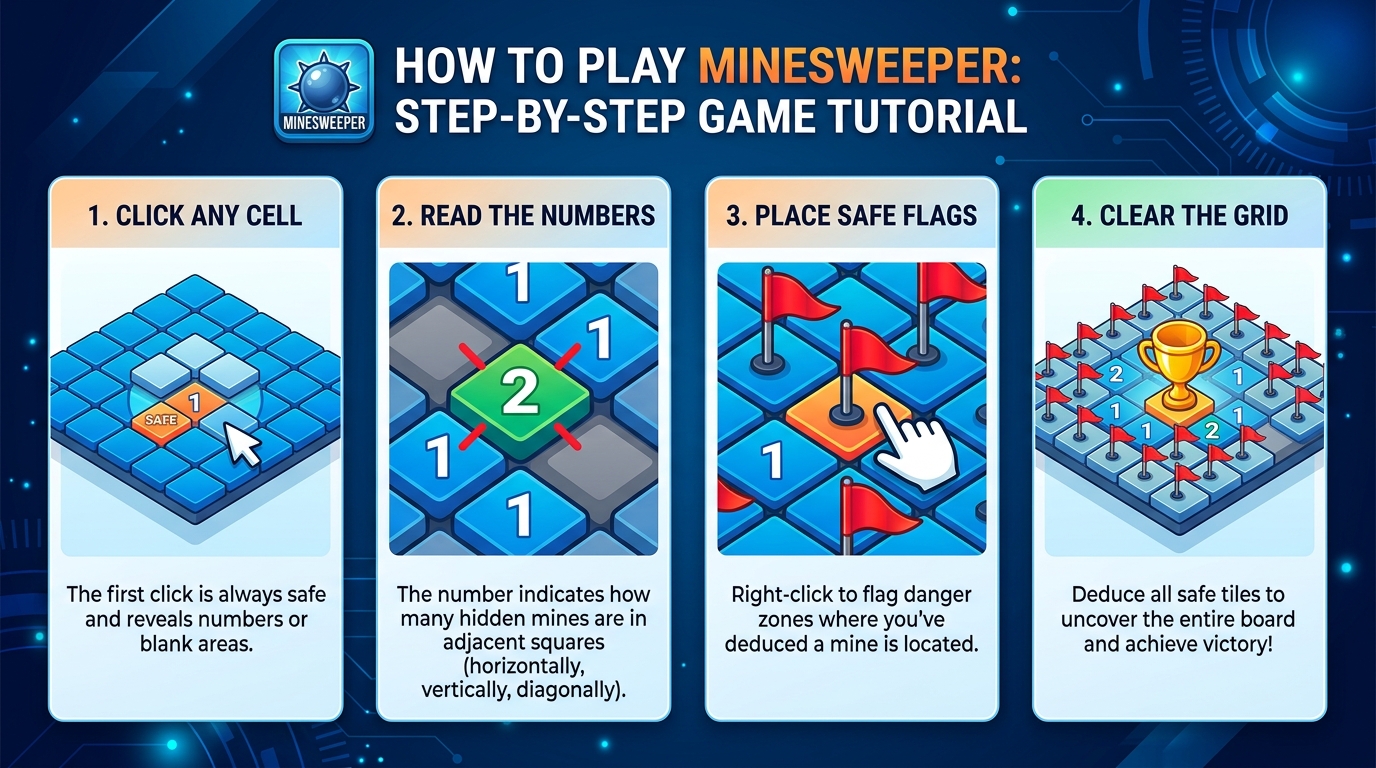
1. How Minesweeper Is Played
Minesweeper drops you onto a grid that starts entirely covered. Each cell either hides a mine or shows a number: the number on a revealed cell counts how many of its eight neighbors (including diagonals) hide a mine. Left-click reveals a cell; right-click flags a cell as a suspected mine. If you reveal a mine, you lose. Win by revealing every non-mine cell. The first click is always safe: every ToolWise board is built around an opening cell with zero adjacent mines, so wherever you tap, the reveal opens a real area.
When you reveal a cell whose number is zero, the game automatically cascades outward because all of its neighbors must also be safe. The first move is therefore a discovery move: click near the center and watch a region open up. The puzzle then becomes a slow inference puzzle: which cells around a partially revealed area must contain mines, and which we can rule out?
2. The Number-Subtraction Rule That Unlocks the Game
The single most useful reasoning tool in Minesweeper is the subtraction rule. Pick a revealed numbered cell. Count how many flags already touch it. The number on the cell minus the count of flags touching it equals how many unflagged mines remain among its other unrevealed neighbors.
If that difference is zero, all of the unrevealed neighbors of that cell are safe: every flag worth of mine is already accounted for, so you can safely click any covered neighbor of the cell. If that difference equals the number of covered neighbors, then every covered neighbor is a mine, and you can flag them all without further thinking. Most wins in Minesweeper are sequences of these two deductions cascading out from the boundary between cleared and uncleared regions.
3. The 1-2-1 Pattern and Why Patterns Beat Computation
Most Minesweeper players eventually hit a wall where raw counting does not give them safe squares, but patterns do. The most famous is the 1-2-1 pattern: three numbered cells reading 1, 2, 1 along the edge of a partially cleared region, with three unrevealed cells adjacent to them. The pattern implies the two outer unrevealed cells are mines and the middle one is safe. Internalize a handful of these patterns (1-2-1, 1-2-2-1, the corner-touch 1, the corner-touch 2) and the speed and confidence of your play doubles overnight.
4. The 3,000-Level Journey: How Difficulty Ramps
ToolWise Minesweeper replaced the fixed Beginner/Intermediate/Expert presets with a 3,000-level journey: boards grow in size and mine density as you climb, so the challenge ramps continuously instead of jumping in three steps. Every board is verified by a constraint solver to clear on logic alone — no guessing is ever required — and the first click always opens a guaranteed zero-adjacency cell. Move up only when you finish levels without hovering over the board too often, and when you have stopped flagging cells you cannot justify from the subtraction rule.
Chained Logic Beats Guessing
Minesweeper is the most underrated logic puzzle on the planet. Every revealed number encodes a tiny amount of mine information, and chaining the subtraction rule across a boundary turns the puzzle into a deterministic walk rather than a guessing game. ToolWise Free Online Minesweeper gives you a 3,000-level journey of proven no-guess boards, smooth left-and-right click controls, and a first-click-safe opening so you never start on a mine. Pick a level, count flags carefully, and let the patterns do the work.