
The Complete Guide to Tic-Tac-Toe Strategy and the Perfect AI
Learn the rules of the original three-in-a-row game, the openings that never lose, and what it actually takes to draw against the AI on hard, where it never slips.
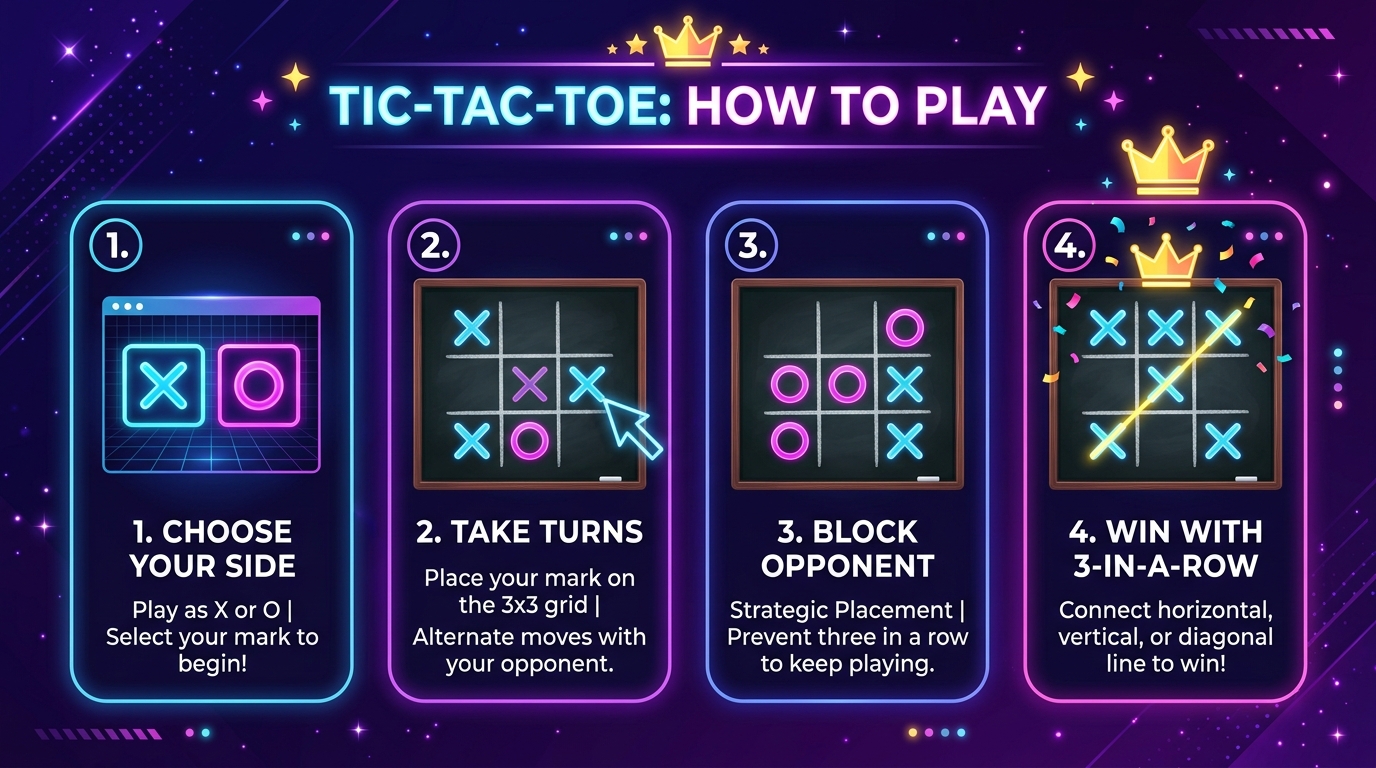
1. How Tic-Tac-Toe Is Played
Tic-Tac-Toe is a turn-based game on a 3x3 grid. Two players alternate placing their symbol, X or O, into any empty cell. X always moves first. The first player to fill any row, column, or diagonal with three of their own symbol wins. If all nine cells fill without a winner, the game is a draw.
Despite being one of the simplest games ever made, Tic-Tac-Toe is mathematically solved. With best play from both sides, the result is always a draw. The interesting question is therefore not who wins but whether the second player can hold the draw against a competent first player.
2. Why the Center Opening Is So Powerful
As X, opening in the center gives you the most flexibility. The center participates in four winning lines, one each in every direction (the two diagonals, the middle row, and the middle column). Corners participate in three lines each; edges only in two. By claiming the center, you threaten more potential lines and force O to respond carefully.
If you would rather attack, opening in a corner is the next best alternative. Corner openings create stronger double-threat patterns after a few moves and let you tempt an unwary O into giving you a winning fork on move five. Edge openings are the weakest because they participate in fewer lines and rarely fork.
3. Defending Against the Fork
A fork is a position where one move threatens two winning lines simultaneously, leaving the opponent unable to block both. The most common fork in Tic-Tac-Toe appears after X opens in a corner and O responds in the center. X then plays the opposite corner: if O takes an edge, X forks between the remaining corner and the opposite diagonal.
The defense is to recognize the threat one move early. When X opens in a corner and you are O, your safest reply is not the center but a side cell next to that corner. Playing the center gives X the option to set up the fork; playing the side removes that option entirely and forces a draw with continued best play.
4. Climbing the 3,000-Level AI Ladder
ToolWise Tic-Tac-Toe gives you a three-step AI selector. Easy and Medium slip and play a random move on a share of turns, so you can practice spotting wins and threats; Hard plays the minimax-optimal move every turn, and the best you can force is a draw.
Use Easy to learn the rules and build the habit of watching for forks, Medium to practice your defense, and Hard to test whether your line of play holds against a perfect opponent. If you draw on Hard, you have proven you cannot be beaten at Tic-Tac-Toe.
Center, Corners, and the Fork
Tic-Tac-Toe is the simplest game of perfect information that still rewards strategy. Knowing the center opening, the corner fork, and the right side-cell defense is enough to never lose. ToolWise Free Online Tic-Tac-Toe gives you a snappy touch-and-keyboard UI, a rival for a friend on the same screen, and an AI you can set from fallible to unbeatable so you can train your defense from your first fork all the way to the optimal draw. Pick your symbol and take the board.