The Complete Guide to Air Hockey
Master paddle positioning, angle control, and the rebound trick to win in local games or online rooms.
How the Game Works
Air hockey is a fast one-on-one duel on a split table: you defend the goal on your edge of the board and attack the far edge. The rules fit in a sentence, so the depth is all positioning, timing, and angles.
- Two paddles, one puck: each player controls a single paddle, and the puck is the only object in play — everything revolves around who touched it last.
- First to the target wins: matches are played to a set number of goals — 7 by default, with 3 and 15 also available. The moment a player reaches the target, the match is over, so every point counts.
- Drag anywhere on your own half: press and drag anywhere on your side of the table and your paddle follows your finger or cursor — mouse and touch both work.
Three modes are available. Local 2P puts both players on one shared screen — blue defends the bottom, orange the top — for head-to-head play on one device. “vs Computer” pits you against the CPU. Online rooms pit you against anyone over the internet.
Paddle Positioning: Stay Between the Puck and the Goal
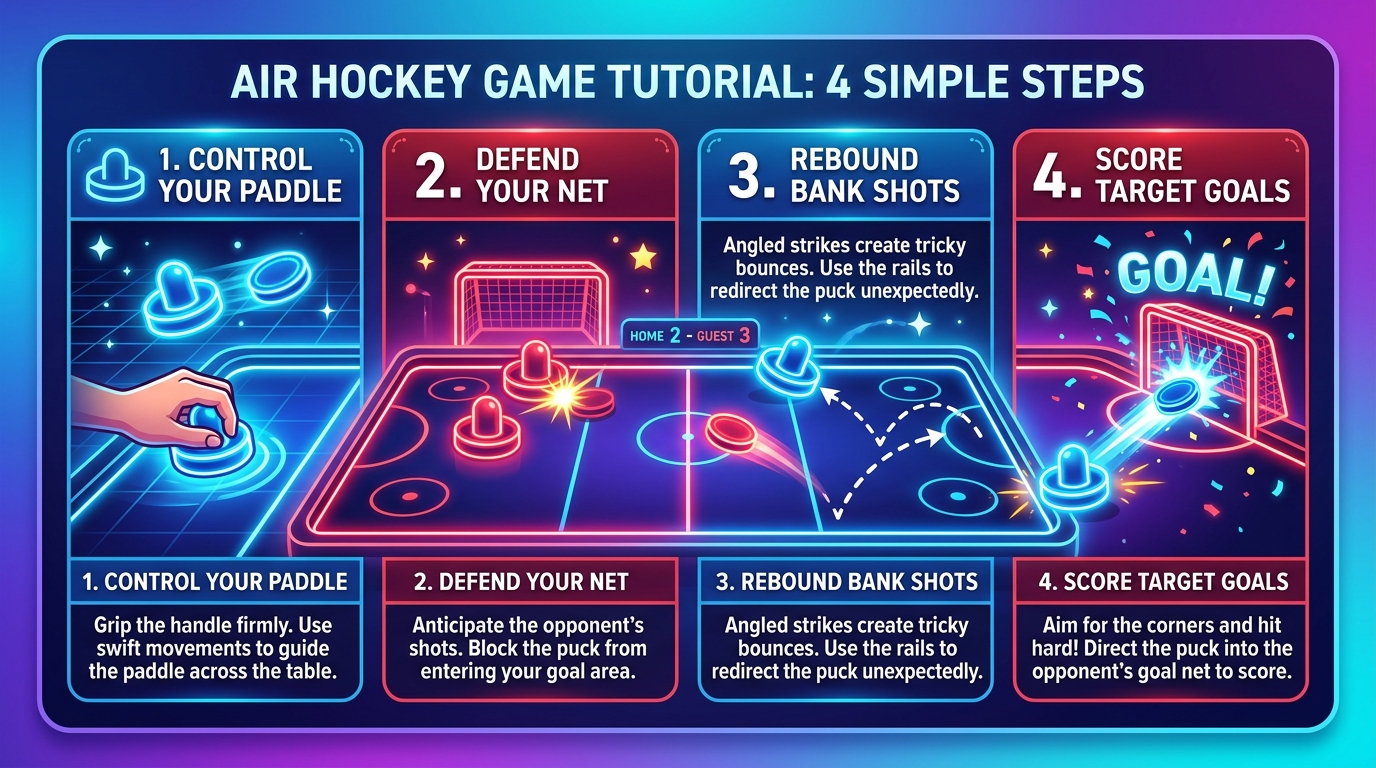
The most important habit in air hockey is keeping your paddle between the puck and your goal — from there you block every straight shot and are never far from safety. When the puck is on their half, resist crowding the center line: drift back, because most goals are conceded by players caught out of position after an attack.
Cutting angles is the next layer. The puck travels in straight lines and bounces off walls, so cover where it will be, not where it is — if a shot will bank off a wall, move to where the reflected line crosses your goal mouth.
The Rebound Trick
The rebound trick — hitting the puck at an angle so it banks off a wall — separates casual players from consistent winners. A straight shot along the obvious line is easy to meet; an angled shot arrives on a completely different line.
It is most devastating against a charging opponent: when they push forward, a banked puck slips past the space they just left and lands behind them.
- Wait for the charge: let your opponent commit forward, then send the puck past the point they just left.
- Aim for the goal-side corners: bank shots there are the hardest to intercept because a paddle has the least room to maneuver.
- Use short, sharp flicks: a quick angled touch is harder to read than a long wind-up.
- Mix straight shots in: if you bank every attempt, good opponents will wait for it.
Balancing Defense and Offense
Air hockey rewards players who switch between defending and attacking in an instant. Pure attackers concede cheap counter-goals; pure defenders get pinned until the pressure cracks them.
- Defend first, counter second: let your opponent overcommit, then punish the open goal — most chances should come off their attacks.
- Never leave your goal unguarded: the puck bounces off walls faster than a paddle can slide across the table.
- Own the center of your half: the middle cuts off straight shots and shallow angles alike.
- Respect the score: with games to 7, one careless goal can decide the match.
How Online Rooms Work
Online play is built around rooms: the host creates one and shares an invite code or link, the guest joins, the host picks the match length (first to 3, 7 or 15) and presses Start match.
- The host runs the physics: the host’s device simulates every collision and both players see the same result — the game stays in sync.
- The host starts the match: the guest cannot move a mallet until the host presses Start match, and the host can start a rematch from the result dialog.
- You control only your own paddle: each player’s drag moves only their own paddle on their own half — no shared screen.
- An invite code or link is all a guest needs: share either one to play from their own device.
- Same rules as local: online matches play to the host’s chosen target (7 by default), so this guide applies unchanged.
Hold the Line, Punish the Charge
Air hockey is easy to learn because the rules fit in one sentence — two paddles, one puck, first to the target — and hard to master because positioning and timing are endless skills. Hold the line between the puck and your goal, cut angles instead of chasing, and use the rebound to punish charging opponents. Balance patient defense with well-timed counters, and remember that online the host runs the physics while you control only your paddle.