The Complete Guide to Online Carrom
Learn the board, master the striker, and play singles, three-player free-for-all or fixed partnerships — against friends or the CPU.
How the Board Works
This is carrom with live physics on a full-size board: every strike, rebound and collision resolves in real time, and the striker always starts from your own base line, between the two red circles.
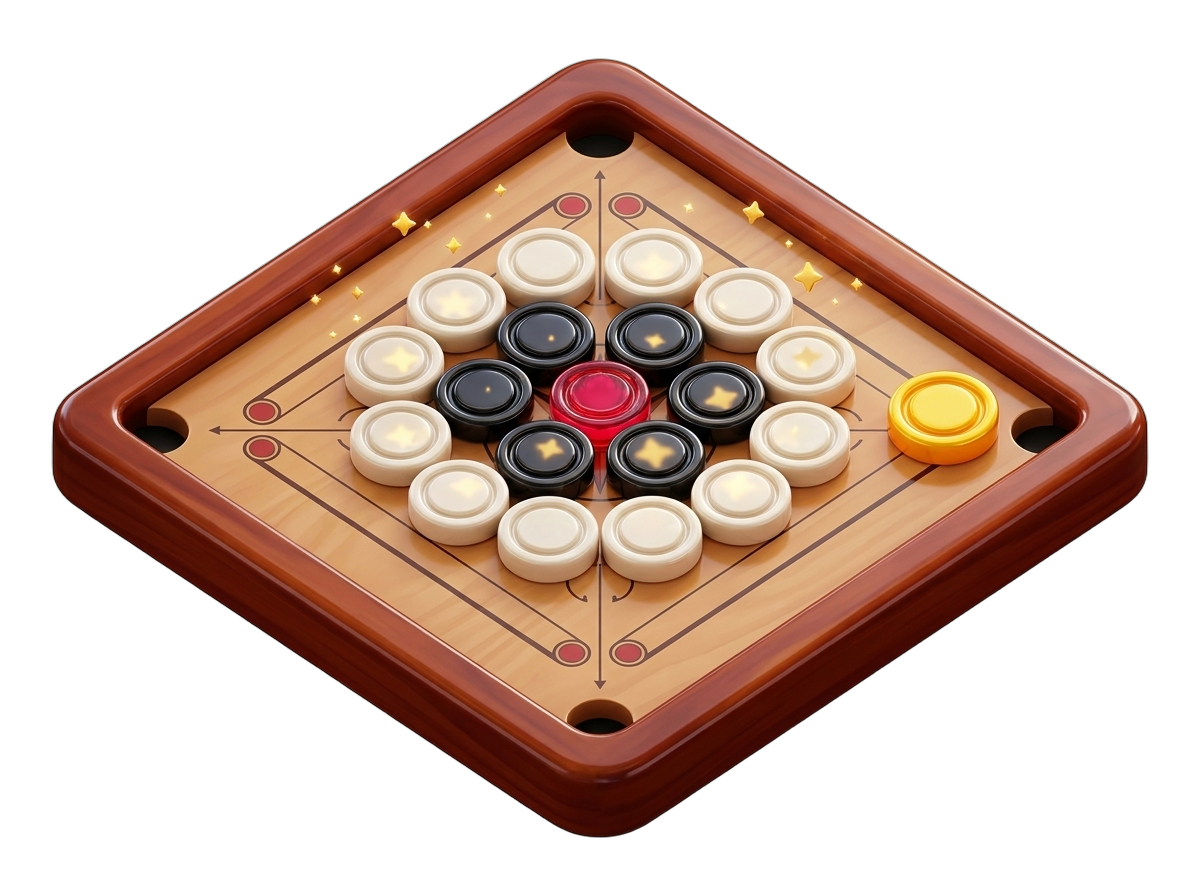
- 9 white vs 9 black, plus the queen: the queen waits at the centre, marked with a gold crown so she is never confused with a man.
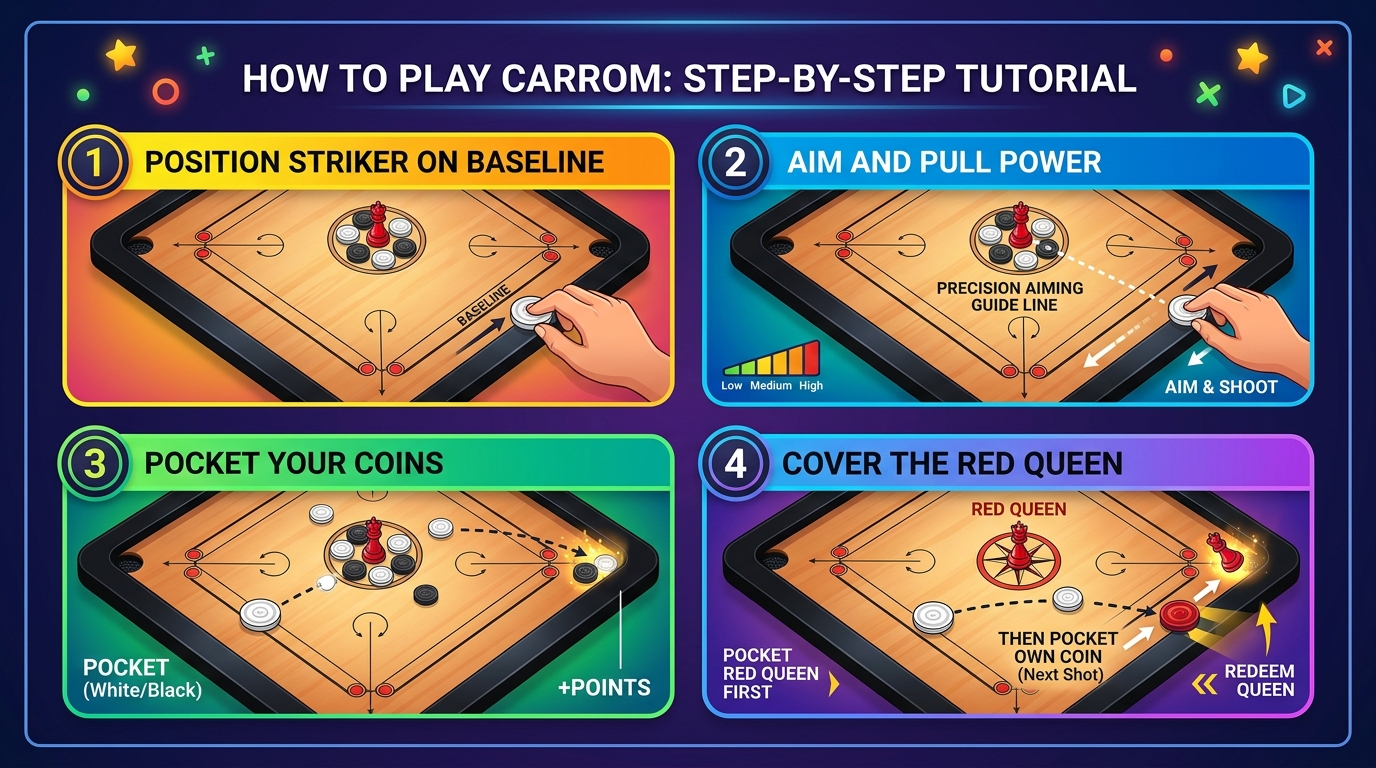
- Base lines and red circles: every edge has a double base line; you place the striker between the two red circles at its ends before shooting.
- Place, pull, release: drag the striker along the line to position it, then pull away from it like a slingshot — the pull length is power and the guide line shows the shot direction.
- Pocket your own colour to keep your turn: every coin of your colour you pocket earns you another strike.
- First to clear their colour wins: the game ends the moment one side pockets its last man, with the queen covered if that side took her.
Seat Counts: Singles, Free-for-All and Partnerships
Use the seat tabs above the board to choose any of four modes, all on the same board.
- Local 2 — singles: White against Black, shooting from opposite base lines.
- Local 3 — rotating free-for-all: Player 1 takes White, Player 2 Black, and Player 3 a second set of men shown in red so every player's coins are visually distinct. Turns rotate around the table and everyone keeps their own nine-man score.
- Local 4 — fixed partnerships: seats 1 and 3 are White, seats 2 and 4 are Black, and partners sit on opposite edges — a 2v2 with a shared colour and a shared score.
- vs CPU: you play White against a computer opponent that simulates its candidate shots with the same physics before choosing one. Set Easy, Normal or Hard in the settings sheet.
- Online rooms: the same seating, live — pick 2, 3 or 4 seats when you create the room and share the code or invite link. Only the host starts the match.
Striking Technique
Striking is the whole game, and two habits do most of the work.
- Placement first: slide the striker along the base line to find the angle before you pull. Moving the striker changes every line on the board, so a well-placed striker turns a hard cut into a straight shot.
- Pull length is power: short pulls for delicate taps near a pocket, long pulls for long-range shots and breaks. The power meter shows exactly how hard the shot will land.
- Aim through the centre of your target coin: line the guide up to run through the middle of the coin and onward to the pocket — off-centre contact sends the coin somewhere you never planned.
- Let rebounds work for you: bank shots off the bumpers and ricochets between coins are legitimate tools whenever a direct line does not exist.
The Queen and the Fouls
The red queen is the board's prize, but she is never yours on pocketing alone. Pocket her and you must cover her by pocketing one of your own men — either in the same strike or on the immediately following strike of the same turn. Pocketing her alone earns you that follow-up shot; if the turn ends without a cover, she returns to the centre. She can never be taken after your last man has been pocketed.
Fouls decide close games. Pocketing the striker returns one of your already-pocketed men to the centre and hands the turn over — if you have not pocketed anything yet, the penalty is owed and paid on your next pocket. Pocketing an opponent's man loses the turn even if you also sank one of your own. Pocketing an opponent's last man before the queen is settled is a foul: the man goes back on the board and the turn passes.
Defensive Play
When you cannot pocket, the next best move is making your opponent's shot worse.
- Break clusters: tight groups of coins are easy multi-pocket opportunities for whoever shoots next — crack them open early so your colours scatter toward pockets.
- Block the striker line: leave coins sitting on the straight lines between your opponent's remaining targets and the pockets, forcing them into low-percentage angle shots instead of clean taps.
- Play the percentages when behind: if your opponent is one or two coins from winning, deny their easiest remaining coin rather than chasing a long shot of your own.
How Online Rooms Work
Online play is built around rooms, and the board behaves exactly as it does locally.
- Create a room and share the invite: the host passes the code or link around, and the host starts the match once everyone is seated.
- The host drives the physics: their device simulates every strike and collision, and everyone sees the same result — no disputes about where a coin landed.
- Same rules as local play: pocket your colour to keep your turn, cover the queen when she falls, and first side to clear their colour wins.
- Live seat order: the room shows each seat's colour and who is shooting next, so turn order around the table is always clear.
The Points Score
When a side clears its colour, the board is scored as well as won: the winners take 1 point for every opponent man still on the board, plus 3 points if they covered the queen. That is why experienced players chase the queen early — a covered queen is worth three coins' worth of margin in a tight finish.
Win the Small Edges
Carrom is a game of small edges: a slightly better striker placement, a line traced through the coin's centre, a queen attempt made only with a cover ready. Pocket your own colour to keep the turns rolling, slow your opponent with defensive shots, and remember that a striker in a pocket hands your turn to the other side. Pick a seat count, load the board, and start sinking coins.