The Complete Guide to Gomoku: Five in a Row Strategy
Master boards from 9×9 to 19×19 with center control, double threats, and the blocking discipline that turns five stones into a win.
How the Game Works
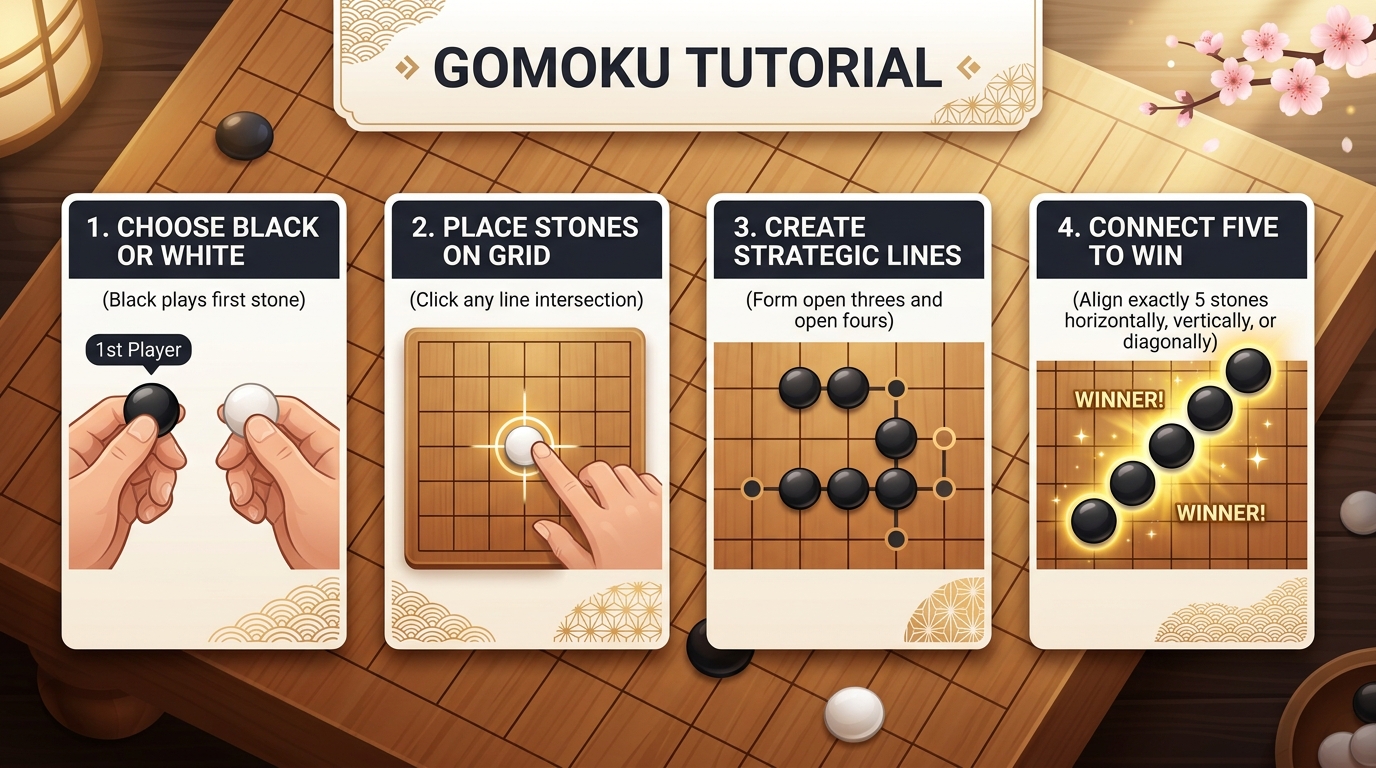
Gomoku is played on a square grid — choose 9×9, 13×13, 15×15 (the classic), or 19×19. Two players alternate placing stones — one black, one white — on empty intersections, and once placed a stone never moves. The first player to get five of their stones in a row wins immediately, and that line can run horizontally, vertically, or diagonally. If the board fills with no five in a row, the game is a draw.
The rules take a minute to learn, but the strategy runs deep: every stone stays on the board forever, so each placement shapes all future threats. The site offers three ways to play:
- Local 2-player: share one device and pass it back and forth.
- Vs Computer: pick Easy, Medium, or Hard — the AI hunts winning lines, blocks your fours, and slips more often on the lower difficulties.
- Online rooms: private rooms with an invite code or link, plus Quick match for random opponents.
Undo is available in Local 2-player and Vs Computer games: it rewinds your last stone and, against the computer, the reply as well, so it is your turn again. Online matches are host-authoritative and never rewind — a misplaced stone has to be played around.
Opening Strategy: Fight for the Center
The opening decides how many directions your lines can grow — and direction is everything. A stone near the edge can only extend a few ways; a stone in the middle can extend in all of them.
- Take the center first: a stone at the center can extend in eight directions — four straight and four diagonal. Central control is the single biggest opening advantage.
- Stay close as player two: respond adjacent or diagonal to the first stone. Playing far away cedes the middle.
- Keep stones connected: early stones should touch your other stones so lines can branch into forks later.
The Double Threat: Your Unstoppable Weapon
A single threat can be blocked. Two threats at once cannot — that is the endgame in one sentence. An open four with both ends empty completes on either end, so no single block stops it. But the most reliable win is the fork: one placement that creates two threats at once, such as an open four plus an open three, or two open threes. Your opponent can only answer one; you complete the other.
- Build lines that cross: aim your stones so a future move sits at the intersection of two growing lines.
- Think two stones ahead: picture where your next stone will land and what the two placements create together.
- Sequence your threats: an open three forces a block, and that forced reply sets up your follow-up four. Forced moves let you dictate the board.
Blocking Tactics: Answer Every Open Threat
Defense wins as many games as offense. Never let a live threat mature while you chase your own plan.
- Answer an open four immediately: it completes on either end, so ignoring it loses on the spot. This is the one non-negotiable block in the game.
- Block simple fours next: a four with one end empty still completes unless you occupy that end.
- Handle open threes early: an open three becomes an open four in a single move, so deal with it before it matures.
- Count before you attack: scan for your opponent’s open threes before committing. Attacks that ignore a live threat hand the game over.
How Online Rooms Work
Online play puts a human on the other side of the same board — the host picks the size, plays black, and starts the match once the guest has joined.
- Create a room: you receive an invite code and a shareable link. Send either to your friend; when they join, the host starts the match.
- Quick match: skip the setup and get paired with a random waiting opponent instantly.
Practice against the computer, then take those tactics online — human opponents punish lazy blocks far faster.
Conclusion: Read the Whole Board
Gomoku rewards foresight over speed. Control the center so your lines can grow in every direction, build double threats instead of single ones, and answer every open threat before you attack. Do those three things and five in a row becomes a habit. Create a room, share the code, and put the strategy to work.