
The Complete Guide to Memory Match and Training Your Working Memory
Learn the rules of the classic concentration game, the strategy that lets you win with fewer moves, and how grid size affects the optimal play style.
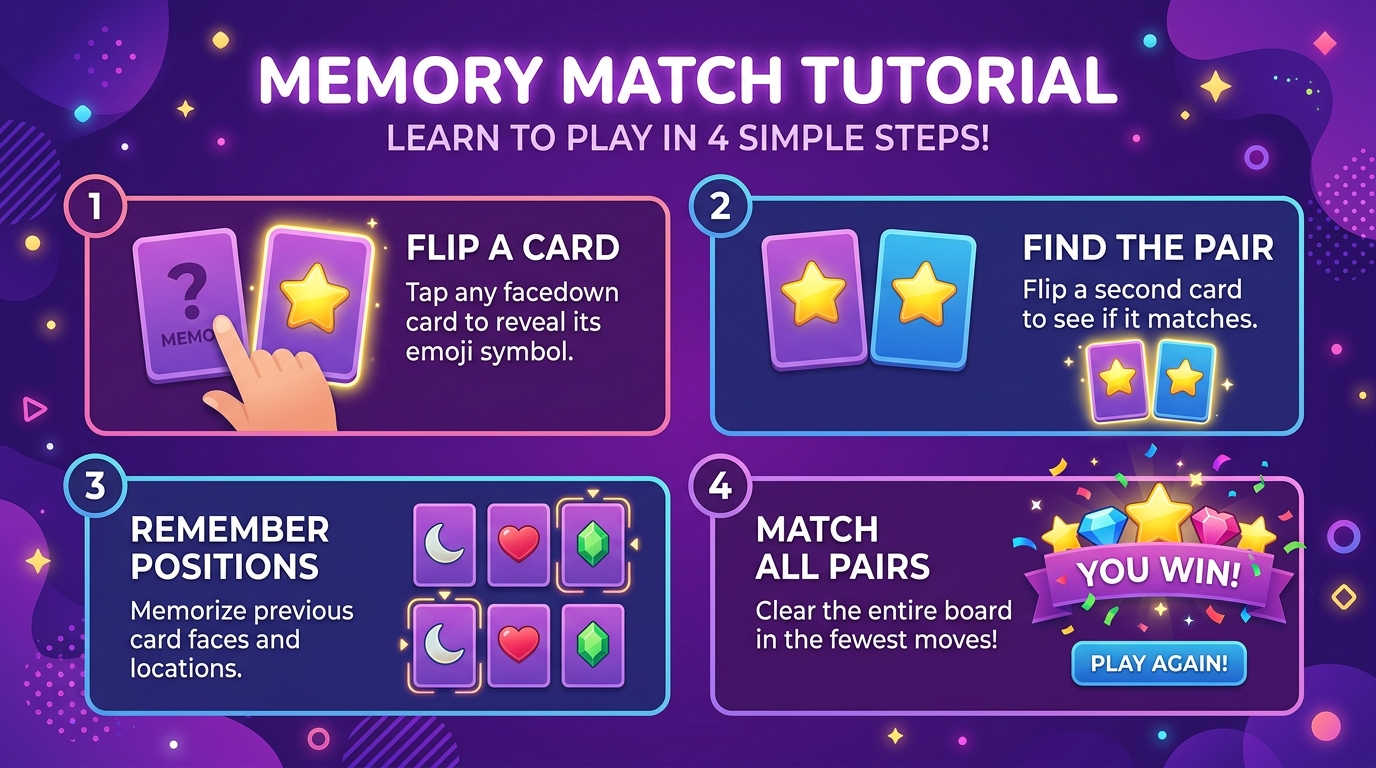
1. How Memory Match Is Played
Memory Match (also known as Concentration or Pairs) is a card-flipping game. The game lays a deck of cards face down on a grid. Each turn you flip two cards. If they match in symbol or color, they stay revealed permanently. If they do not match, both flip back over after a short delay. You win when every card has been paired. The score is the number of moves you took; fewer is better.
Because cards you reveal and then flip back stay literally visible to you, watching them is the entire skill. Every wrong flip is not just a miss, it is information. The trick is to put that information into your memory before you flip the next card.
2. The Two-Phase Strategy That Beats Every Grid
Optimal play has two phases. In the reconnaissance phase, you flip pairs of unknown cards even when you know they will not match. The goal is to reveal as many distinct cards as possible while building a mental model. Treat each wrong flip as a free reveal of two positions, not a wasted turn. In the collecting phase, you use the model: any time you flip a new card and remember a match for it somewhere on the grid, you collect that pair immediately. Every new reveal in the collecting phase should produce a known match.
A common mistake is to stop flipping new cards too early. If you switch into pure collecting before you have seen most of the deck, you will flip cards blindly because your model has gaps. Roughly two-thirds of the deck should be known before you stop flipping new pairs.
3. How Grid Size Changes the Game
On a 4x4 grid (8 pairs) the entire deck fits inside most adults' working memory. A few plays of practice and you can two-phase the board realistically moving under 16 flips. On a 6x6 grid (18 pairs) the working-memory load approaches the limit for most humans, and you have to start grouping cards by region or by symbol category rather than remembering individual cells. On the biggest boards you need a system: divide the grid into quadrants and reconnaissance one quadrant at a time, holding each match in short-term memory long enough to collect it.
4. Racing Friends Online
Online rooms are a race, not a shared board: every player gets their OWN deck and plays at their own pace. The host chooses the board size (6–18 pairs), how long each board's clock runs (Easy, Hard or Expert), whether the race is won on time (most boards before the clock) or on a board target (first to clear N boards), and how many peeks each player may use. Standings update live, finished players wait for the rest, and the final table ranks everyone by boards cleared with total moves as the tie-break. Journey levels, stars and the fewest-moves record stay solo-only.
Recon First, Then Collect
Memory Match rewards attention more than reflex. The two-phase strategy, reconnaissance then collecting, plus a grid-size-appropriate memory-load discipline gives you near-optimal play on the smallest boards and a fighting chance on the biggest. ToolWise Free Online Memory Match gives you adjustable grid sizes, a countdown to beat, and the best moves count saved in your browser. Pick a grid size, slow down, and watch the deck reveal itself to you.