The Complete Guide to Playing Hangman and Guessing Words Like a Pro
Learn the rules of the classic word-guessing game, the letter-frequency order that maximizes recoveries early, and how to use pattern gaps to read the word.
1. How Hangman Is Played
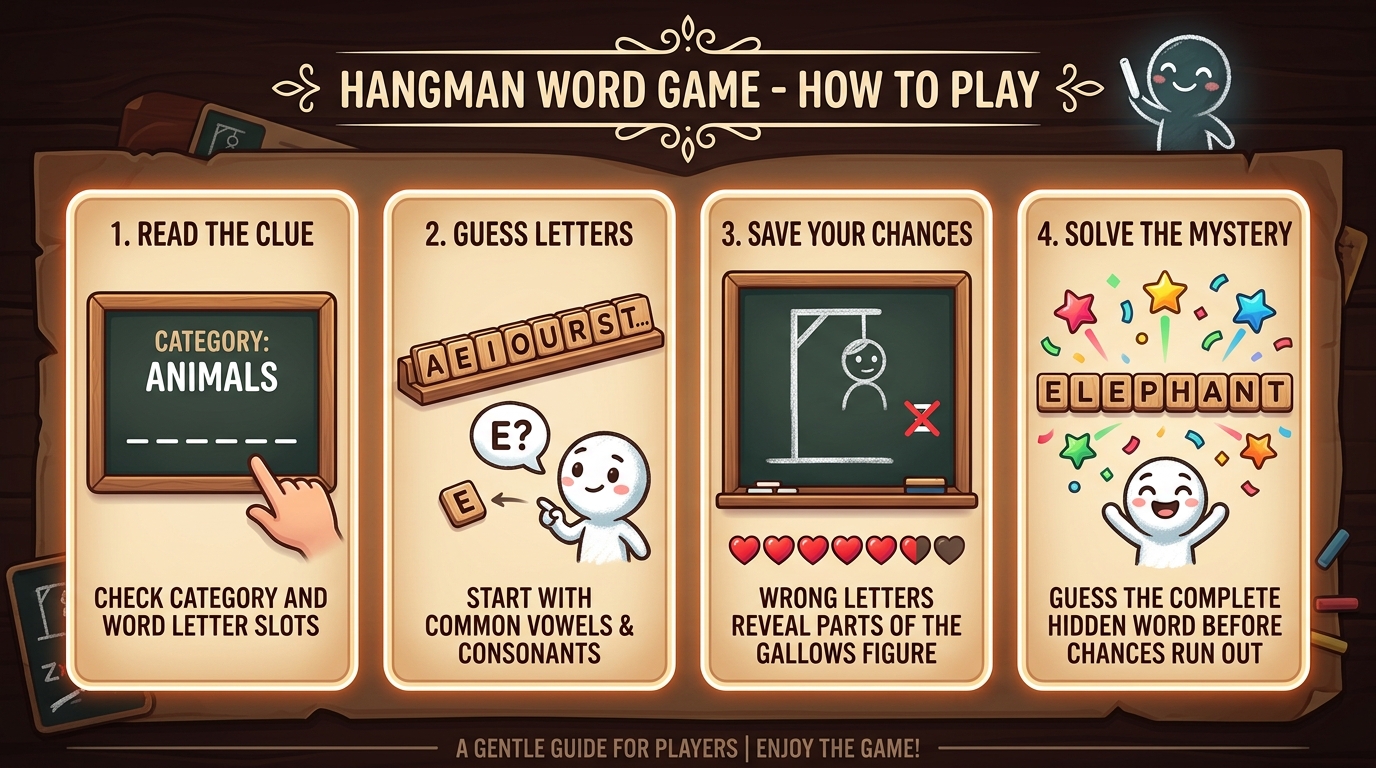
Hangman is a word-guessing game. The game picks a hidden word and shows you a row of blank cells equal to the word's length. You guess letters one at a time. Each correct guess reveals all positions where that letter appears. Each wrong guess advances a drawing: six wrong guesses completes the hangman, after which you lose. You win if you reveal the entire word before using all your wrong guesses.
Word length alone gives you heavy information up front. A 3-letter word is rarely an obscure verb because the puzzle relies on common vocabulary to be fair. An 8-letter word almost always comes from the general English vocabulary you can reasonably guess; spotting meaning by length is part of the strategy.
2. The Letter-Frequency Order That Wins Games
English letter frequencies are surprisingly stable. The vowel-heavy and the most common consonants should be your first guesses. A widely used order is E, A, R, I, O, T, N, S, L, C, U, then the rarer letters. Start with E; if the word has no E, switch to A; if no A, try R, then I, then O.
Some wrapper letters are also weakly informative: S signals plural endings; T often begins -TION/-TH patterns; R frequently sits next to vowels in past-tense -ER endings. Each correct guess cascades: once you see T_I_ in the early game you almost always have the word TIME.
3. Reading the Pattern: Why Gaps Matter More Than Letters
The trick to beating hangman past turn four is pattern recognition rather than raw spelling vocabulary. Two known letters at the start of a four-letter word signal the S sound cluster (SH, SP, ST) more than any other option; two letters at the end of a long word combined with -TION, -ING, or -ED endings are strongly predictive. Cross the word length and tail with vowels you have already revealed, and most hidden words become obvious in two or three more guesses.
When you are stuck, flip the question mentally. Ask yourself which words of this length contain every letter you have already guessed: usually only a handful do, and you can march through the remaining candidates with smart consonant probing rather than guessing wildly.
4. Picking Your Difficulty
ToolWise Hangman offers three tiers instead of a long unlock ladder. Easy deals 3–6 letter words so you can practice letter order and pattern spotting without punishment. Medium deals 7–9 letters, where most words are won or lost on your third and fourth guesses. Hard deals 9+ letters, which is where the strict six-guess budget starts to bite and the -TION, -ING and -ATE endings earn their keep.
Themed categories are available in every tier, and custom-word mode lets you hand a friend a word of your own choosing for a local two-player round. Co-op rooms let two players guess the same word together from different devices.
Vocabulary Meets Probability
Hangman is part vocabulary, part probability. Guessing the most frequent letters first turns six wrong guesses into a comfortable cushion, and pattern reading finishes off the word before you spend them all. ToolWise Free Online Hangman gives you five themed word banks across three difficulty tiers, a clean drawing, hints at a price, and lifetime stats saved to your browser. Pick a category and start pulling letters off the alphabet.