Roman Numeral Converter Guide: Rules, Chart & How It Works
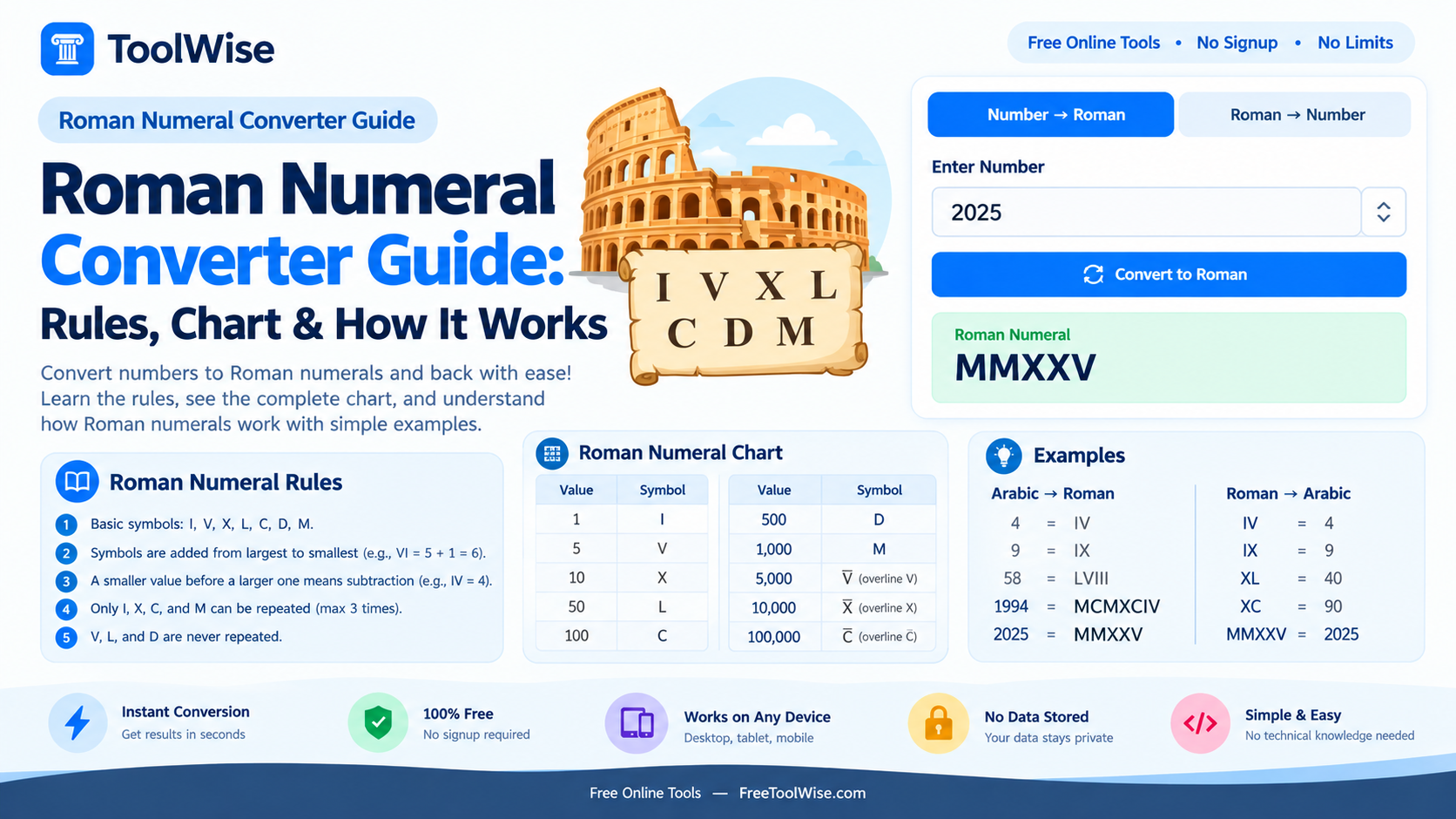
Roman numerals look like a code from another age because, in a sense, they are one. A handful of letters — I, V, X, L, C, D, M — carry the entire counting system on their shoulders, and once you learn the two or three rules that govern how they combine, you can read any number you meet on a clock, a title page, or an outline without hesitating. This guide explains those rules, works through the conversion by hand, and shows where the system quietly runs out of room.
The Seven Roman Numerals and Their Values
The entire system rests on exactly seven symbols, each with a fixed value. Master these and every longer numeral is just a matter of reading them in order:
| Symbol | Value | Memory hook |
|---|---|---|
| I | 1 | one finger |
| V | 5 | an open hand |
| X | 10 | two open hands |
| L | 50 | half of C |
| C | 100 | century, cent |
| D | 500 | half of M |
| M | 1,000 | mille, millennium |
Notice the structure: the values step in a pattern of powers of ten (1, 10, 100, 1,000) each paired with a “five times” marker (5, 50, 500) in between. Roman numerals have no zero and no place-value system, so this symbol set has to do all the work of representing quantity through repetition and combination.
How the Symbols Combine Into Numbers
At its core the system is additive: write the symbols largest to smallest and add their values. XVI is 10 + 5 + 1, or 16. MMXXVI is 1000 + 1000 + 10 + 10 + 5 + 1, or 2026. Because the arrangement always runs from largest to smallest, you can read a numeral left to right and simply accumulate, which is why the system stays readable even when a string gets long.
Repetition does the rest of the work inside each power of ten. The same symbol can repeat up to three times, so III is 3 and XXX is 30. Four of anything, though, is where the additive approach pauses — instead of writing IIII, the system introduces its one piece of cleverness, the subtractive rule.
The Subtractive Rule and Why It Exists
The subtractive rule states that when a smaller symbol appears immediately before a larger one, you subtract it instead of adding it. IV is 5 − 1 = 4, and IXis 10 − 1 = 9. The rule keeps notation shorter — otherwise every 4, 9, 40, 90, 400, and 900 would need four repeated symbols.
The rule is strict about which subtractions are allowed. Only a symbol that is one or two steps smaller can precede a larger one: I can go before V and X, X before L and C, and C before D and M. That yields exactly six valid subtractive pairs — IV, IX, XL, XC, CD, and CM — and it is why 1998 is MCMXCVIII rather than some shorter invented form. Recognition of those six pairs is the entire trick to reading confidently.
Converting Numbers to Roman Numerals by Hand
Converting a number like 1987 is easiest when you break it into its place values first — thousands, hundreds, tens, ones — and convert each piece independently, then concatenate:
For each place value, write the thousands with M’s, the hundreds with C’s and D’s (remembering that 400 is CD and 900 is CM), the tens with X’s and L’s, and the ones with I’s and V’s. When a piece lands on one of the subtractive pairs, use it; otherwise stack the symbols additively. The final numeral is just the four pieces in order, with no separators and no arithmetic left to do.
Roman Numerals Beyond 3,999
The standard system has a natural ceiling. With M as the largest symbol and repetition limited to three, the biggest number you can form under the ordinary rules is MMMCMXCIX, or 3,999. For anything larger, the Romans themselves used variants, and modern typography carries on the idea with a vinculum — a bar placed over a numeral (or group of numerals) that multiplies its value by 1,000.
Under that extension, V̅ means 5,000 and X̅ means 10,000, and you can stack the same combining rules on top of the barred symbols. Most people never need this, but it explains why a respectable-looking numeral written with a bar is not an error — it is the traditional answer to a system that otherwise runs out at a surprisingly low ceiling.
Common Mistakes and Ambiguities
- Repeating a symbol more than three times. IIII for 4 is technically readable but non-standard; the canonical form is IV. The three-repetition limit is a rule, not a suggestion.
- Using invalid subtractive pairs. Substituting IIX for 8 or IC for 99 produces forms that break the one-and-two-step rule. Only the six sanctioned pairs are correct.
- Treating it as positional. There is no zero and no “tens column.” XL is not “four-zero”; it is 40, and reading it as anything else is a category error.
- Mixed-case sloppiness. The convention is uppercase. Lowercase roman numerals exist (i, ii, iii…) for specific contexts like front-matter page numbering, but they are the same values in smaller print.
When in doubt, the safest path is to validate. The Roman Numeral Converter reads a numeral under the standard rules and rejects invalid combinations, so a form you are unsure about gets a definitive answer in either direction.
Reading Years and Dates in Roman Numerals
Years are where most people meet Roman numerals in the wild — on a cornerstone, a book’s copyright page, a film’s end credits, or a building dedication. Reading a year works the same way as reading any other number, but the four-digit form deserves a quick once-over because the thousands digit dominates the string.
Take MCMLXXXIV, the year 1984. Break it from the left: M is 1000, CM is 900 (the subtractive pair for the hundreds), LXXX is 80, and IV is 4 — totalling 1984. The moment you recognise CM as “900” rather than trying to add C and M separately, the whole number resolves in one pass. That pair, plus the sibling pair CD for 400, does nearly all the heavy lifting for any year after roughly 1300.
Dates like edition numbers and outline levels use the same rules at smaller scale: a volume marked Vol. VII is the seventh, an outline point labelled i., ii., iii. is the third under a Roman-numeral heading scheme. The only difference in these contexts is presentation — lowercase numerals for list items, uppercase for prominent titles — but the values behind them never change.
One practical habit makes all of it faster: learn the six subtractive pairs (IV, IX, XL, XC, CD, CM) as atomic units rather than as a rule to apply on the fly. Once your eye reads “CM” as eight-hundred-ninety-nine-and-nothing-else, the same way you read “ch” as a single sound, a year like MCMLXXXIV stops being an arithmetic puzzle and becomes something you absorb in a glance — which is exactly how the numerals were meant to be read by the people who carved them.
Frequently Asked Questions
What are the seven basic Roman numerals?
Why does 4 appear as IV rather than IIII?
What is the highest number you can write in standard Roman numerals?
Does the order of symbols always go from largest to smallest?
Can I use the converter to check my own Roman numerals?
Where do Roman numerals still get used today?
Convert any number to Roman numerals
Type an Arabic number or a Roman numeral and the ToolWise Roman Numeral Converter returns the other side instantly, validating the rules as it goes — entirely in your browser.
Open Roman Numeral Converter →