Morse Code Translator Guide: Alphabet, Timing & How It Works
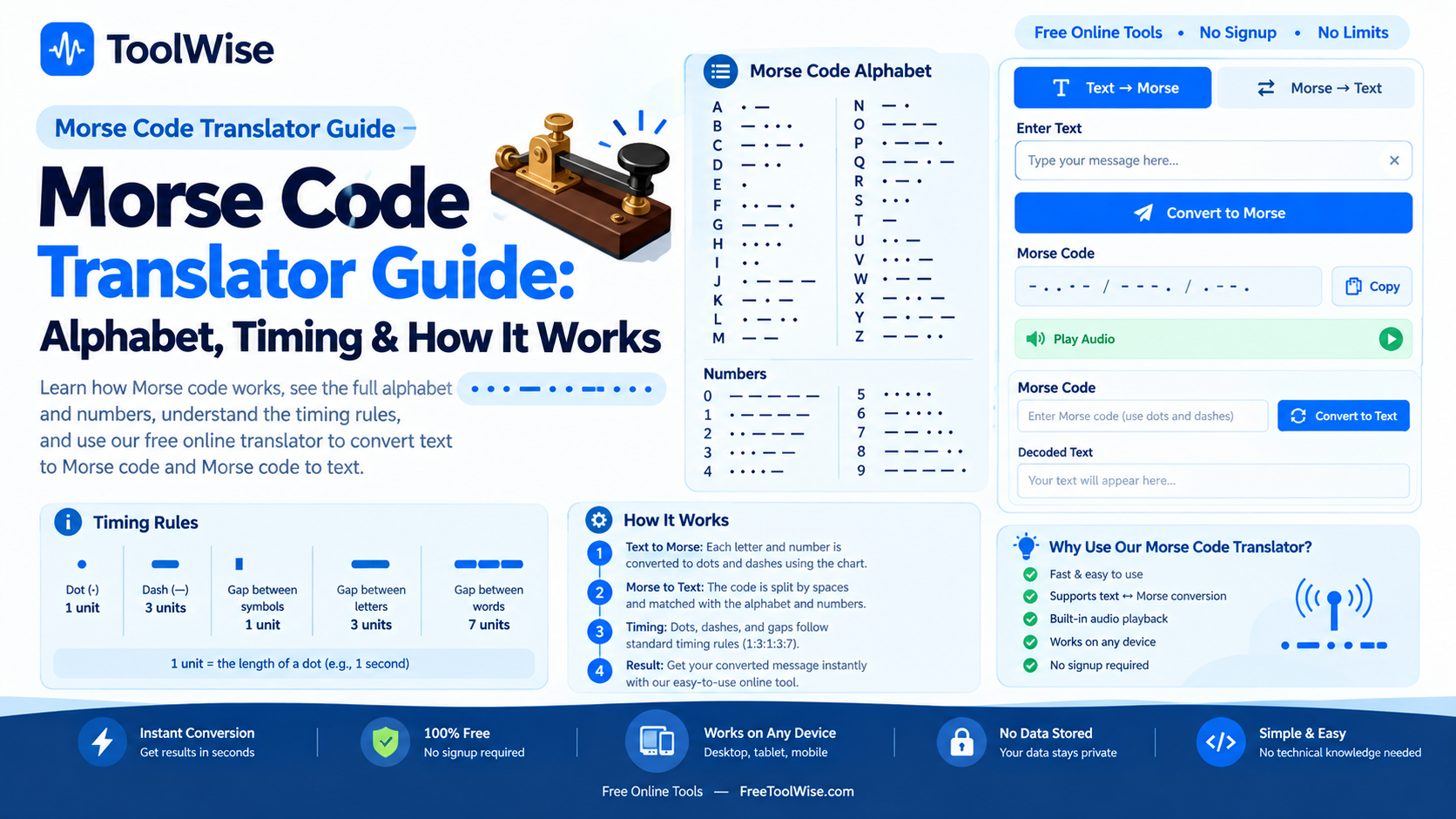
Morse code is one of the oldest forms of electronic communication, and it is still one of the most elegant — a whole alphabet built from just two signals and the silences between them. This guide explains how the dots and dashes work, what the timing gaps mean, how to encode and decode ordinary text, and how to actually learn the code instead of just admiring it.
What Morse Code Is and Where It Came From
Morse code is a method of encoding text as a sequence of two signal states — conventionally called dots and dashes — separated by gaps of silence. It was developed in the 1830s and 1840s for the newly invented electric telegraph, where a wire could carry only an on-or-off current, and it turned that single channel into a full writing system.
The genius of the design is that it needs almost no hardware. Any two distinguishable states work as dots and dashes — sound on and off, light on and off, radio carrier present and absent — which is why the same code has been tapped, flashed, and beeped across technologies for nearly two centuries without needing to change. The version used today is International Morse Code, standardised in the mid-1800s specifically so it would work across languages and alphabets.
Early Morse came in national variants that did not fully agree, and international standardisation is the reason the code you learn today matches the code anyone else in the world learns. The letters, digits, and punctuation each have one agreed dot-dash pattern, and every other detail is timing.
Dots, Dashes, and the Spaces Between
The unit of Morse code is the dot, the shortest signal. A dash is three dot-lengths long. What confuses beginners is that the pauses are not just empty pauses — they are structural, and the code cannot be read without them.
- Within a letter: the gap between a letter’s dots and dashes is one dot-length.
- Between letters: the gap is three dot-lengths, so the reader knows one letter has ended and the next is starting.
- Between words: the gap is seven dot-lengths, marking a clean word boundary.
Because every gap is measured in ratios rather than absolute time, the entire code scales with speed. A message sent slowly and one sent fast have the same proportions and read identically — the receiving ear (or eye, or software) locks onto the rhythm and recovers the same text at any speed.
The International Morse Alphabet and Numbers
Each character has a fixed pattern, and the patterns were assigned by a deliberate logic: the most common letters in English got the shortest codes to make transmission faster. E is a single dot, T is a single dash, while rare letters like Q and Z stretch longer. That frequency-based design is why Morse is compact in practice even though it represents each letter individually.
| Letter | Morse | Letter | Morse |
|---|---|---|---|
| A | .- | N | -. |
| B | -... | O | --- |
| C | -.-. | P | .--. |
| D | -.. | Q | --.- |
| E | . | R | .-. |
| F | ..-. | S | ... |
| G | --. | T | - |
| H | .... | U | ..- |
| I | .. | V | ...- |
| J | .--- | W | .-- |
| K | -.- | X | -..- |
| L | .-.. | Y | -.-- |
| M | -- | Z | --.. |
Digits follow the cleanest pattern in the system: 1 through 5 are counts of dots finished with dashes (1 = .----, 5 = .....), and 6 through 9 mirror them with dashes first (6 = -...., 0 = -----). Once you know the 0–5 half, the rest is symmetry.
Encoding Text to Morse Code
Encoding is a lookup: take each character in your text, find its pattern, and write the patterns in order, putting the standard gaps between letters and words. A word like HELLO becomes .... . .-.. .-.. ---. The process is mechanical, which is exactly what the Morse Code Translator does in real time as you type.
Two details matter when encoding. First, case: Morse has no uppercase or lowercase, so encoding is case-insensitive — HELLO and hello produce the same signal. Second, unsupported characters: anything outside the defined alphabet, digits, and punctuation has no code, so a good encoder either skips it or flags it rather than silently inventing a sequence. For practical use, keep the source text within standard characters and let the translator handle the spacing.
Decoding Morse Code Back to Text
Decoding runs the lookup in reverse — split the incoming signal on the letter gaps, then on the word gaps, and match each letter pattern to its character. The harder part in live audio is recovering those gaps reliably, since real signals arrive with noise and imperfect timing. For text written in dots and dashes, though, the decode is as mechanical as the encode.
A written Morse message uses a single space between letters and a slash or multiple spaces between words (-.-. --- -.. . / ..---)for “CODE 2”). Software follows the same convention, and a translator’s decode is the fastest way to verify that a hand-written conversion is correct — paste it in, read back the text, and any mismatched pattern shows up immediately as a gap or an unknown character.
Practical Tips for Learning Morse Code
- Learn by sound, not by sight. Morse was designed for ears, and memorising the visual dot-dash charts only gets you so far. Practise hearing the rhythm and the letters will stick far more reliably.
- Start with the high-frequency letters. E, T, A, I, N are the shortest and most common codes; getting them fluent first unlocks a surprising share of real text.
- Use spaced repetition. A few minutes daily beats an hour once a week. The gaps between practice sessions are part of what makes it stick.
- Send before you race. Accurate timing matters more than speed. A fast but muddled signal is unreadable; a slow and clean one is not.
- Practise both directions. Encoding alone teaches recognition in one direction. Alternate writing text as Morse and reading Morse back to keep both paths sharp.
Special Signals: SOS and the Prosigns
Beyond ordinary letters and numbers, Morse has a small set of prosigns — procedure signals made by running two letters together without the usual gap between them. They are shorthand for common operational messages. The most famous is SOS, sent as ...---..., which is written as the nine signals run together rather than as S-O-S with letter gaps.
SOS is a distress symbol, not the only one. A handful of prosigns still matter to anyone operating radios: AR (“end of message”), K (“over to you, go ahead”), R(“received”), and the emergency tone that precedes formal distress traffic. They are used in aviation and maritime radio, and a few — like the “73” for “best regards” — survive as friendly shorthand between operators.
The prosigns illustrate the deeper point that Morse carries two layers: the letters themselves, and the way letters are grouped and timed. Learning the characters is the first half; learning which combinations are conventionally run together is where Morse becomes a working protocol rather than a novelty. It is also why a decoder built on the standard letter and word gaps will read a prosign as separate letters until you tell it that the gap was intentional.
Frequently Asked Questions
What is the difference between a dot and a dash?
Is Morse code still used today?
How do you separate letters and words in Morse code?
What is the Morse code for SOS?
Can Morse code handle punctuation and numbers?
Does the Morse code translator send my text anywhere?
Translate text to Morse code instantly
The ToolWise Morse Code Translator encodes text to Morse and decodes Morse back to text with live preview and audio playback — free, in your browser, nothing uploaded.
Open Morse Code Translator →